Measure first: the three numbers that decide everything
Every failed small library began with shopping instead of measuring, so take the three numbers before anything else. Wall length: the uninterrupted stretch you can actually give, measured between door frames, windows, radiators, and outlets, not the wall's full architectural length. Depth budget: how far shelving can project before it crowds the room's traffic, which is 10 to 12 inches in a living room, 8 to 10 in a hallway, and less beside a bed that needs its walking side. Chair footprint: the reading chair is the library's engine, and its space, roughly a three foot square with room to extend legs, must be reserved before the shelves take the rest. Write the three numbers down and shop against them. A format from the table that fits all three will succeed in a small home where a grander format that fits two will fail, because a library that fits gets used daily and a library that almost fits becomes storage with ambitions.
The one wall run
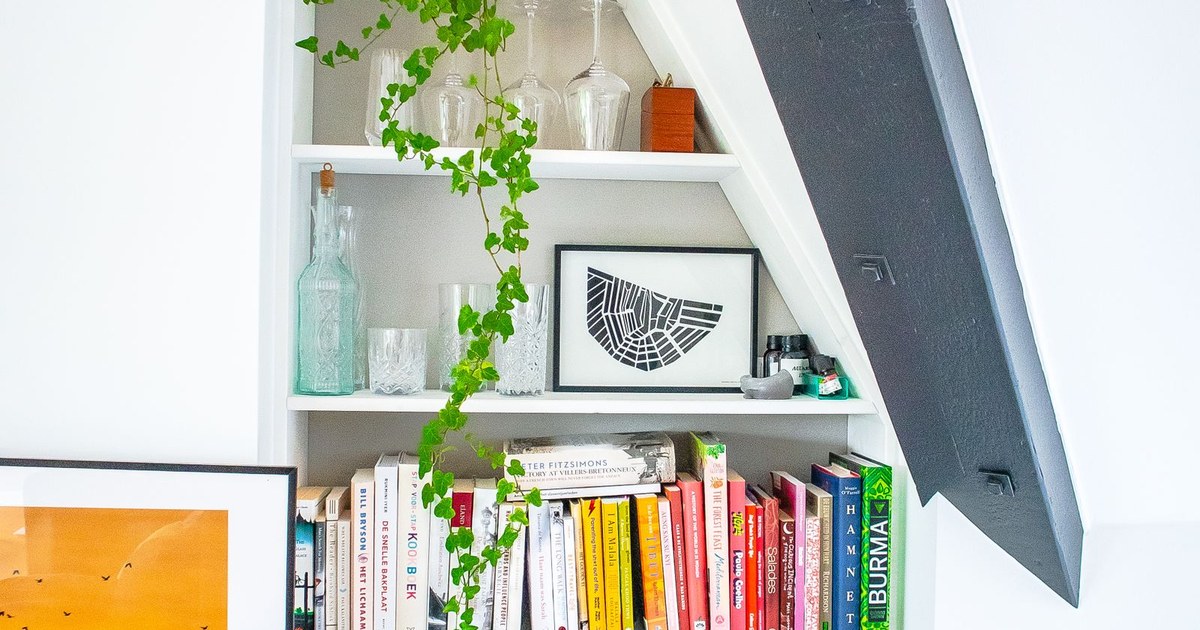
Give the shortest wall in the room to books, floor to ceiling. A short wall filled completely reads as architecture, while the same cases spread thinly along a long wall read as clutter, and the difference is why some small libraries look designed and others look apologetic. Tall matching bookcases side by side make the wall; a simple frame across the top or a shared paint color makes separate cases read as one built piece. Put daily reads between knee and eye height, heavy art books and reference low where their weight belongs, and the rarely opened books on top, reached by a small step stool that lives beside the chair. Leave a few sections open for a plant, a framed photo, or a stack lying flat, so the wall breathes and the eye has somewhere to rest. Anchor at least the end cases to wall studs, because a fully loaded tall case is a tipping risk in any home with children, pets, or uneven floors. The wall run is the format for the reader with several hundred books and one honest wall, and it rewards being finished completely rather than grown case by case in mismatched heights.
The hallway run
Hallways are the cheapest library space in the house because the floor is already spent on walking. Shelves here must be shallow, 8 to 10 inches deep, which suits paperbacks and standard hardcovers perfectly and keeps the corridor passable; measure your largest books before assuming, because oversize art books are the usual exception and they can live on the wall run or the cart instead. A low run of shelves capped at about 42 inches doubles as a display ledge for art above it, turning a passage into a gallery that happens to hold two hundred books. Keep the run on one side only, light it with a small wall fixture rather than relying on the hall's ceiling light, and never let it narrow a route you would need in the dark or in a hurry. Hallway libraries serve browsing better than sitting, so pair the run with the chair wherever the chair fits, even in another room: the ritual of choosing from the hall and carrying to the chair is one many readers come to love, and it makes a small home feel like it has a library wing.
The closet conversion
Take the doors off a spare closet, paint the interior a color you love, ideally deeper than the room's walls, and line the back and side walls with shelves. A bench cushion or a deep floor pad on the closet floor makes the seat, and a battery wall light or a clip lamp solves the wiring problem without an electrician. Use the side walls for shelving as well as the back, and keep the center clear for sitting, with a cushion deep enough for a child and an adult side by side at story time. A curtain on a ceiling mounted rod replaces the doors and can close you into the smallest private library in the house, a room within a room for the price of fabric. Closet nooks are adopted fastest by kids and teens, who treat them as secret rooms, and many a reluctant reader has been converted by a fort that happens to be full of books. Two honest limits: a closet library holds one reader, or one reader and one small listener, and it needs the closet to be genuinely spare. A household still storing winter coats in it does not have a closet to convert; it has a hallway run waiting to happen.
The seat, the light, and the cart
Whatever the format, the chair decides whether the library gets used. Choose it before the shelves if you must choose: deep enough to tuck your feet up, arms at a height to rest a book and a drink on, fabric that survives daily use rather than fabric that photographs well. Place it in the best natural light you have and give it a small table within arm's reach and a lamp behind the shoulder, warm and dimmable, because reading light should fall on the page, not in the eyes. If no format fits at all, a two tier rolling cart is a real library and not a consolation prize: current reads on top, next reads below, parked beside whichever chair the day offers and tucked into a corner at night. A cart holds a season of reading, rotates with your interests, and serves renters and dorm rooms where nothing may be drilled or built. Many small libraries begin as a cart beside a good chair and grow into a wall run when the home allows, which is the correct order: habit first, furniture second, architecture last.
Rules that keep small shelving safe and usable
Fasten floating shelves into studs and respect their weight ratings, because books are far heavier than they look and a shelf of hardcovers is a load, not a decoration. Keep spans short, heavy books low, and every tall unit anchored, and recheck anchors after the first month, when the cases have settled under their real weight. Small libraries die from one cause more than any other: running out of room and piling books in front of books, which hides a third of the collection and turns browsing into archaeology. Leave a fifth of every shelf empty on day one, and the little library will still be working years from now. The companion rule is a gentle one in, one out discipline for the cart and the closet, where capacity is truly fixed. And keep one shelf, somewhere at eye height, for the current handful: the book being read, the next two, and the one being lent or returned. That shelf is the library's dashboard, and a visitor who sees it understands the whole room. The checklist on this page walks the four formats and the safety rules in order, so a small library can be planned on paper before a single case is bought.
For renters and the drill shy
Nothing in the four formats requires owning the walls. The wall run can be freestanding cases, anchored with furniture straps to a single discreet point or, where even that is barred, chosen in low, wide, stable units that do not need anchoring at all. The hallway run works as a row of low bookcases rather than mounted shelves. The closet conversion needs no construction: a tension rod carries the curtain, battery lights carry the lighting, and freestanding shelves sized to the closet's interior do the rest, all of it removable in an afternoon with the deposit intact. The cart, of course, asks nothing of anyone. The renter's real constraint is not permission but weight and moving: buy cases you can carry up stairs and out again, in modules that fit a car, and your library becomes the rare piece of a home that moves with you intact, shelves, chair, and all.
A worked layout: the twelve foot studio wall
To make the formats concrete, here is the smallest complete library this page recommends, fitted to one twelve foot wall of a studio apartment. Four feet of the wall take two low cases, waist height, holding the hallway style shallow shelves for paperbacks and the current collection; their tops form the display ledge and, beside a window, the plant shelf. The chair sits in front of the remaining wall at an angle to the light, with the rolling cart as its side table, current read on top, next reads below, lamp behind the shoulder on the cart's other side. Above the low cases, one floating shelf, stud anchored and kept short, holds the dozen books the reader most wants visible. Nothing here reaches above waist height except that single shelf, nothing needs a ladder, the traffic lane stays clear, and the whole library, cases, cart, chair, and lamp, can move to the next apartment in one car trip. Scale it by the table: more wall becomes a wall run, a spare closet becomes the nook, but the proportions, chair first, shallow shelves, one ledge, a fifth left empty, survive every scaling.
Kids in a small library, and the maintenance rhythm
A small library shared with children succeeds on two adjustments. Heights invert: the child's current books belong at the child's eye level, not in the leftover bottom shelf, and a closet nook or the low end of a hallway run, stocked at kneeling height with a cushion in front of it, will be used daily by a reader who ignores a beautiful tall case entirely. Rotation does the rest: a small home cannot display every picture book it owns, and it does not need to, because a monthly swap of a dozen books between a storage box and the low shelf makes old books new again at no cost. For the library as a whole, the maintenance rhythm is seasonal and light. Once a season, walk the shelves with a box: remove what will honestly never be reopened, repair the one shelf that has started to double stack, and restore the empty fifth before it disappears. Small libraries rarely die of bad design; they die of slow silt, one gift book and one sale pile at a time, and a four times a year hour of weeding is the whole cost of preventing it. The library that is maintained stays a room. The one that is not becomes a warehouse with a chair in it, and the chair, in the end, is the part that mattered.
Frequently asked questions
What is the smallest space that can hold a home library?
A rolling cart and a good chair: about two square feet of movable floor. A cart holds a season of current and next reads, and beside a chair with a lamp it performs every function of a library except storage. The closet conversion is the smallest fixed library, at the footprint of one closet.
How deep should shelves be in a small library?
Ten to twelve inches for a living room wall run, which fits standard hardcovers with room to spare. Eight to ten inches in a hallway, which fits paperbacks and most hardcovers while keeping the corridor passable. Measure your largest books first; oversize art books are the usual exception.
How many books fit in a small home library?
A floor to ceiling wall run of six to ten feet holds several hundred. A hallway run holds one to two hundred. A closet conversion holds a snug personal collection around its seat, and a two tier cart holds a current reads collection of a few dozen. Capacity matters less than the empty fifth rule in the safety section.
Is a closet library practical, or just a photo trend?
Practical, with two conditions: the closet must be genuinely spare, and the seat and light must be solved, usually a deep cushion and a battery or clip lamp. Closet nooks are adopted fastest by children and teens, and they convert reluctant readers because the space feels like a fort that happens to hold books.
Do I need to anchor bookcases in a small library?
Yes, for tall units. A fully loaded tall case is a tipping risk around children and pets, and anchoring at least the end cases of a wall run to studs is the rule on this page. Renters can choose low, wide, stable cases that do not require anchoring, or use furniture straps where a single point is allowed.