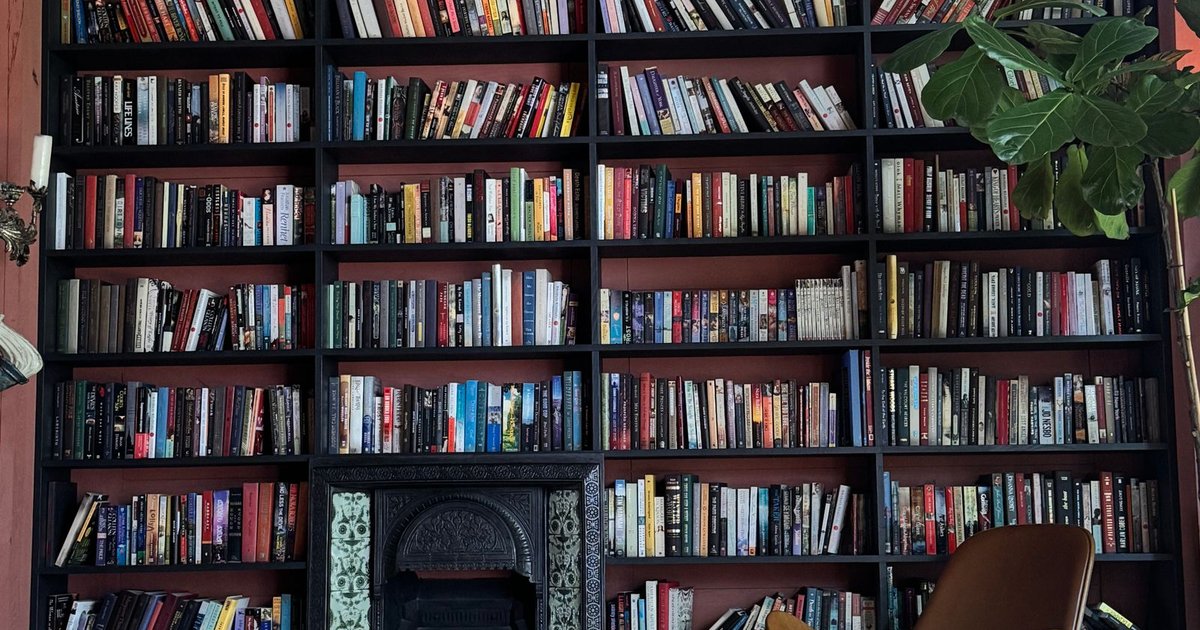
Designing a library at home works best as a sequence of decisions, not a pile of photographs. The rooms that fail are almost never ugly; they are rooms where the style decision was made first and the structural decisions were left to chance, so the shelves bow, the chair faces a wall, and the light lands everywhere except the page. This guide runs the sequence in the order it has to be run: fix the room's job first, then the shelf wall, then the seat and the light, and style last, with a room by room table of what each candidate space gives up and protects.
Step zero: choose the room by what it protects
| Room | What it protects | What it gives up | Watch out for |
|---|
| Spare bedroom | A door that closes, quiet, guests can wait | A guest room | Damp exterior walls |
| Living room wall | Daily visibility, books get used | Privacy and silence | Television competition |
| Hallway or landing | Dead space becomes the library | Seating, almost entirely | Passing traffic and dust |
| Dining room | A big table for spreading out | Formal dining | Food steam and spills |
| Closet or under stairs | A true nook, cheap to finish | Airflow and light | Heat buildup, no outlet |
| Attic or basement | Space nobody else wants | Climate control | Moisture, the book killer |
The room's job is the first decision and the only irreversible one: is this library a retreat, a display, a working collection, or a family's shared shelf? A retreat needs a door and one chair. A working collection needs a table and the best light in the house. A shared family library needs to sit on the route people already walk, because books behind a closed door in an unused room are storage, not a library. Decide the job in one sentence before measuring anything, and let every later decision be graded against that sentence.
Step one: the shelf wall, measured honestly
Measure your twenty tallest books before buying or building a single shelf; that one measurement sets the shelf heights and prevents the classic failure of a library that cannot shelve its own art books. Standard working numbers: shelf depth of 10 to 12 inches holds nearly every book a home owns, with one deeper run, 14 to 16 inches, for oversize volumes laid flat or standing. Vertical spacing of 10 to 12 inches between shelves covers most hardcovers, with one tall bay at 14 to 15 inches. Anchor tall cases to wall studs, always: a loaded bookcase is among the heaviest objects in a home, and it is top heavy exactly when a child or a cat climbs it. Support any span longer than about 36 inches at its center, because a shelf that bows a quarter inch this year bows an inch in five. Put the heaviest books, reference sets, atlases, bound journals, on the lowest shelves, and leave ten percent of every shelf empty; a library with no growth room starts dying the day it is finished.
Step two: the seat, placed before the style
The seat is the library's engine, and it is placed second because everything else arranges around it. One genuinely comfortable chair, with arms at reading height and support for a two hour sit, beats a photogenic bench that nobody survives for a chapter. Place the chair where the room's best natural light falls over a shoulder, not into the eyes and not behind a screen of glare, and within reach of one shelf designated the reading shelf: current book, next book, and the reference volume the household actually opens. A small table at elbow height for a drink and a notebook completes the station. If the room's job is shared or working rather than retreat, the seat decision becomes a table decision instead: a table that seats four, with chairs people can sit in for an hour, under the best light, with the shelves on the walls around it.
Step three: light, in three layers
Library light fails in one layer at a time, so build it in three. Ambient light first: enough ceiling or wall light that the room never feels like a cave at night, on a warm color temperature that flatters paper rather than the blue white of an office. Task light second: one real reading lamp at the chair, positioned over the shoulder opposite the hand that turns pages, bright enough to read small print without strain, and adjustable, because the right angle at forty is not the right angle at seventy. Shelf light third, and it is optional but transformative: low strips or picture lights that wash the spines make the room feel finished and make browsing at night a pleasure instead of a squint. Keep direct afternoon sun off the shelves themselves; ultraviolet fades spines and dries bindings, and the sunniest wall in the room is for the chair, not the books.
Step four: style, last and lightly
Style comes last because it is the only layer that is cheap to change. Once the room's job, shelves, seat, and light are right, style reduces to three choices: the shelf finish, the textile palette, and what hangs on the one wall the books do not cover. Paint the room a color you can read in for hours, which for most people means a mid tone, neither stark white nor cave dark. Let the books supply the color; a working library is already the most decorated room in the house. Resist arranging by color unless the collection is small and mostly decorative, because a reader's library is organized for finding: by subject, by author, by the household's own logic, with the finding system written down somewhere a guest or a grown child can use. The most beautiful home libraries in photographs are usually the least findable, and a home library exists to be used on a Tuesday night, not to be photographed on a Saturday.
Climate and care: the unglamorous layer
Books are hygroscopic, which is a technical way of saying they drink the room's air. Keep the library in the ordinary comfort band of the house, neither the damp basement corner nor the attic that bakes in August, and treat any musty smell as an emergency rather than a charm: mold spreads shelf to shelf through the air. Dust the tops of books with the room's normal cleaning, keep food and drink rituals to the chair side table rather than over open shelves, and open the room's air on dry days if it is a closed nook or closet conversion, where heat from lighting and still air are the standing risks. None of this is precious; it is the same care a kitchen gives knives, applied to the most durable information technology ever made.
The budget order: where money actually shows
Home library budgets fail by being spent in the order things are photographed rather than the order they are used. The correct spending order is: seating first, because a chair you cannot sit in makes every later purchase decorative; task lighting second, because the best shelves in the world fail under bad light at 9 p.m.; shelving third, bought or built once, at the honest measurements, rather than twice at guessed ones; and only then the visible layer of paint, textiles, and objects. A reader with a modest budget should know that the middle of this order is where libraries are won: a serious reading lamp and a chair with real support transform a corner with two bookcases into a library, while the reverse purchase, beautiful cases and a stool, produces a photograph. Buy used where the category allows it without risk: solid wood cases and lamps age well and circulate cheaply, while upholstered seating should be sat in before it is bought, whatever the listing promises. Leave ten percent of the budget unspent at the end. Every finished library discovers one need in its first month of use, a footstool, a side shelf for the reading pile, a warmer bulb, and the reserve is what turns that discovery into a purchase instead of a regret.
The one wall library: designing small
Most homes do not have a room to give, and the one wall library is the honest answer for them: a single wall of shelving, floor to ceiling where the ceiling allows, with the chair angled toward the room's best light and a lamp standing between them. Design it as a room within the room. The wall takes the deepest shelves the space allows at its center and shallower ones at the edges, which keeps the wall from reading as a cliff. A rug under the chair defines the floor of the invisible room and, in an open plan space, does more than any screen to make the library feel like a destination rather than a corridor. Keep the collection honest at this scale: a one wall library holds roughly a thousand volumes at full stretch, and its discipline is the current shelf rule, books that are being read, reread, or consulted live on the wall, and the deep archive lives in boxes elsewhere, rotated seasonally. Small libraries designed this way get used daily, which is the entire point; the grand library in the unused front room, admired on the way to the kitchen, is furniture. Measure your wall, run the sequence in this guide at one wall scale, and the smallest library on this page will outperform it.
Working collections: the reference shelf rule
If the room's job is working rather than retreating, one more system earns its space: the reference shelf, a single shelf at standing height beside the door or the desk, holding the dozen books the household actually consults, the dictionary, the atlas, the field guide, the cookbook that is really a reference, the manual for the house itself. Reference books fail in beautiful libraries because they are shelved by subject among books that are read in chairs, so consulting one means a search, a climb, and a return trip. At standing height by the door, a fact can be checked in under a minute, which is the difference between a library that informs the house's arguments and one that merely decorates them. Review the shelf yearly; reference books expire faster than any others in the room, and last decade's atlas is a history book wearing the wrong label.
Finally, plan the library's second year at the moment you finish its first. Note which shelf filled first, which chair hour went unused, and which light failed in winter that worked in June, because a library is a system that reports on itself through use. The rooms that stay loved are the ones whose owners treat the first year as a draft: the sequence in this guide gets the structure right, and a year of reading in the room tells you where your own version of the structure wants to bend.
The checklist on this page follows the same sequence as the guide, room's job, shelf wall, seat, light, style, care, so the design can be worked as a project over weekends rather than admired as an essay. Tick each layer only when it is true in the room, not when it is purchased; a library is finished when it is used, and the checklist's last box, sat and read for two hours, is the only one that certifies the rest.
More home library ideas
Frequently asked questions
What is the first step in designing a home library?
Decide the room's job in one sentence: retreat, display, working collection, or shared family shelf. That decision determines whether the room needs a door, a table, the best light, or a position on the family's daily route, and every later choice, shelves, seat, light, and style, is graded against it.
How deep should home library shelves be?
Ten to twelve inches deep covers nearly every book in a home collection. Add one deeper run of 14 to 16 inches for oversize books. Measure your twenty tallest books before building, and space most shelves 10 to 12 inches apart vertically, with one tall bay for art books and atlases.
Where should the reading chair go?
Where the room's best natural light falls over your shoulder, within reach of the shelf that holds your current and next books, with a small table at elbow height. Comfort is the test: a chair you can read in for two hours beats a beautiful chair you leave after twenty minutes.
How do I light a home library?
In three layers: warm ambient light so the room works at night, one adjustable task lamp at the reading chair angled over the shoulder, and optional shelf lighting that washes the spines. Keep direct afternoon sun off the shelves themselves, because ultraviolet light fades spines and dries bindings.
Should I organize my home library by color?
Only if the collection is small and mostly decorative. A working library should be organized for finding, by subject, author, or your household's own system, with the system written down so anyone can use it. Color order looks striking in photographs and makes a specific book nearly impossible to locate.