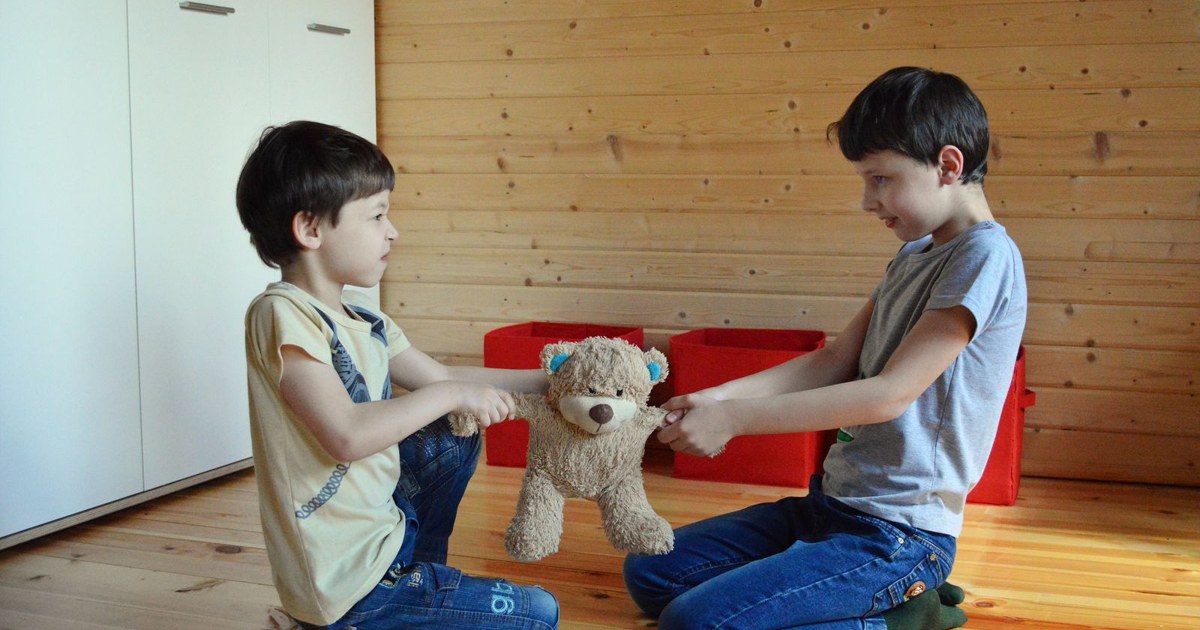
Every toddler hits. The arm is fast, the words are slow, the frustration is enormous, and the nearest surface is often a beloved face. Parents arrive on this page wanting the hitting stopped, and the books below are sequenced to do something better than stop it once: they install the rule, teach the replacement, and calm the body, in that order, because that is the order a toddler can learn them in. The rule book comes first, one phrase the whole family can reuse until it becomes the house's law. Then the same lesson extended across the body, feet, teeth, hands again, because toddler hitting is rarely only hitting. Then the moment before, what to do with the surge itself, practiced like a fire drill. Then settling after. A note on expectations before the shelf: these books work in weeks, alongside consistent adult responses, and any page that promises otherwise is selling something. What they genuinely do is give the child, and the adults, a shared language for the hardest minute of the toddler day.
The rule book
Hands Are Not for Hitting by Martine Agassi (first published 2000, and in board book form since 2009) is the foundational text, and its design is smarter than its simplicity suggests. Each spread pairs the prohibition with the invitation: hands are not for hitting, and hands are for waving, clapping, drawing, hugging, helping. The rule is never left standing alone as a negation, because a toddler told only what not to do owns a vacuum, and vacuums get filled by experiment. The book's refrain becomes, in households that use it properly, the adult's entire script in the moment, hands are not for hitting, said flatly, while moving the hands to one of the book's approved occupations. That flatness matters. The phrase works because it is boring, identical from every adult, at every incident, and the book exists as much to standardize the grown ups as to instruct the child. Buy the board edition; it will be read at close range by the population it describes, and it should be able to survive being sat on.
The rest of the body, same lesson
The Best Behavior series, published by Free Spirit, extends the identical architecture across the body, and the consistency is the therapy. Feet Are Not for Kicking by Elizabeth Verdick (2004) addresses the child whose protest travels downward, kicking at changes, at car seats, at siblings, and redirects feet to stomping, marching, dancing, and kicking balls, which are named as the legitimate glory of feet. Teeth Are Not for Biting by Elizabeth Verdick (2003) handles the toddler classroom's most distressing habit with unusual honesty about its causes: teeth hurt when they are growing, mouths explore, frustration bites when words cannot, and the book gives the bitten child sympathy and the biter a set of alternatives, chew this, say that, find a grown up. Parents of biters should read its adult notes, which are brief and sane. Together the three books form a complete body curriculum in one voice, one visual grammar, and one refrain structure, so the toddler is never learning a new system, only a new verse of the house song. That is exactly how rules consolidate at this age: not by argument, but by rhythm.
What to do instead, and calming down
What to Do When You Feel Like Hitting by Cara Goodwin (2021) is the shelf's workbook, aimed at the slightly older toddler and young preschooler, and it is the only book here that addresses the moment before impact. Goodwin, a child psychologist, names the surge honestly, everyone feels like hitting sometimes, and then trains the replacements as physical skills to be practiced in calm weather: stomp the feet, roar like a lion, squeeze the pillow, blow the pinwheel, ask for a break. Its interactive pages, things to draw, trace, and rehearse, convert reading time into drill time, and the drill framing matters, because a replacement behavior that has never been practiced will not be available at the moment of flood. Calm-Down Time by Elizabeth Verdick (2010) completes the sequence at the far side of the incident: the breathing, the quiet spot, the hug, the recovery, taught in the Toddler Tools series' sturdy board form. It earns its place on this page as well as on the feelings shelf because hitting households need the down escalator as much as the rule, and a child who knows the way down needs the way up less often. The Feelings Book by Todd Parr (2000) supports both from underneath, giving the surge its names at bedtime, when the day's hitting can be revisited as weather rather than crime.
The list at a glance
| Need | Start with | Why |
|---|
| The core rule | Hands Are Not for Hitting | One phrase the whole family can reuse |
| Kicking too | Feet Are Not for Kicking | Same pattern, new body part |
| Biting too | Teeth Are Not for Biting | Causes named, alternatives given |
| The moment before | What to Do When You Feel Like Hitting | Safe physical replacements, practiced |
| Settling after | Calm-Down Time | Breaths, hugs, and a quiet spot |
| Words behind it | The Feelings Book | Naming the feeling shrinks the hitting |
The adult protocol the books assume
No book on this page works without its matching adult behavior, and the protocol is short enough to memorize. In the moment: block the hand, say the book's phrase once, flatly, and move the child or the hands to the replacement, a pillow to squeeze, a ball to kick, water to pour. Do not lecture, do not demand an apology performance, do not ask why, because the honest answer, I was furious and my arm is faster than my words, is one the toddler cannot give you yet. After the moment, briefly and kindly: name what happened, check the hurt child first, always, because the order of comfort teaches the room whose pain counts, and reconnect with the hitter, who is usually frightened by his own weather. Between moments: practice. Read the books in calm weather, rehearse the replacements as games, and praise the near misses extravagantly, you were so mad and you stomped instead, because the behavior you narrate is the behavior that grows. Consistency across adults is the multiplier; a grandparent who laughs at the hitting undoes a week, so the books' phrases should be issued to every caregiver like a dress code. Finally, expect the curve: worse in the first days of a new response, because the old one is being tested for survival, then a decline measured in weeks. That curve is the treatment working, not failing.
When hitting is a referral, not a reading list
Toddler hitting is developmental, and toddler hitting that injures, that is frequent beyond the ordinary storms, that comes with lost language or lost skills, that targets animals, or that frightens the child himself, deserves professional eyes: pediatrician first, who can rule out pain, hearing, sleep, and developmental contributors that no picture book can reach. The same applies when the household's adults find their own responses escalating. None of that diminishes this shelf. It defines its jurisdiction, which is the ordinary, universal, exhausting hitting of the second and third years, and within that jurisdiction these books, run with the protocol above, are the standard equipment.
Hitting at childcare: partnering with the other adults
Many toddlers do their hitting where their parents cannot see it, in childcare, and the call or the note at pickup lands like a verdict. Treat it instead as data and an alliance. Ask the setting what their phrase and routine are, and align the home script with theirs where you can, because a toddler moving between two systems that use the same words for the same moments learns the lesson at double speed, and a toddler whose adults are visibly allied experiences the rule as a feature of the world rather than a preference of one building. Share what works at home, the replacement that takes, the warning sign you have learned to read, and ask for the same intelligence in return; good settings keep exactly these notes and are relieved when parents want them. If incidents cluster, look together for the pattern, the hour, the transition, the contested object, because the fix is usually environmental and boring: a duplicate of the fought over truck, a snack moved earlier, a warning before the tidy up bell. What not to do is punish at home for the setting's incidents, hours later, in another world; the toddler cannot connect the consequence to the act, and the only lesson delivered is that home is where the delayed weather lands. Trust the alliance, review monthly, and expect the curve to bend.
The apology question, settled
Should a toddler who hits be made to apologize? The honest answer is: not as a performance, and yes as a practice, in that order. A forced sorry, extracted in the heat of the moment from a child still flooded, teaches the word as a spell that ends adult displeasure, and children who learn that lesson deploy the spell earlier and mean it less. What builds the real thing is sequence: calm first, always, then the repair, in which the adult narrates the other's state, models the apology herself if she was part of the escalation, and offers the toddler a reparative act scaled to his powers, fetching the ice pack, the tissue, the beloved toy to lend. The spoken sorry arrives when it can be meant, sometimes minutes later, sometimes at bedtime, and a sorry that arrives late and meant is worth a hundred extracted on the spot. Over the year, the modeled repairs become the child's own, which is the only road by which apologies are ever really learned, at any age, in any family.
The other child: repair, and what to say to their parent
Hitting has a second party, and households need a script for that side of the event too, because playground diplomacy handled badly teaches its own lessons. In the moment, attend to the hurt child first, visibly, before managing your own, because both children are watching what harm summons, and the answer must be care. Then the repair from the section above, the calm, the narrated state, the reparative act offered to the child who was hit, an ice pack fetched, a toy lent, a sorry when it can be meant. To the other parent, the honest sentence is short: he is two, he is learning, we are working on it with a plan, and I am sorry yours was hurt. Nearly every parent of a toddler has stood on both sides of that sentence, and it is received in that spirit far more often than the anxious imagination predicts. What corrodes is absence, the parent who looks away, or theater, the parent who performs outrage at their own toddler for the audience. Skip both. The children are learning how harm is handled between people from exactly these thirty seconds, and the curriculum is the adults' conduct, not the toddler's.
More recommendations
Frequently asked questions
What is the best book to stop a toddler hitting?
Hands Are Not for Hitting, used as a household script rather than a story. Its refrain becomes the adults' one flat sentence in the moment, and its spreads teach the replacement occupations. Pair it with What to Do When You Feel Like Hitting once your child is nearing three and can practice the drills.
How long do these books take to work?
Weeks, not days, and the first week often looks worse as the child tests whether the new response is real. Judge at a month, by frequency and recovery time rather than by perfection. A toddler who hits half as often and settles twice as fast is a success story in progress.
Should I read the book right after a hitting incident?
Not as a consequence. Books used as punishment become punishment flavored and get hidden. Read them in calm weather, at bedtime, in the car, and let the storm itself be handled by the short protocol: block, phrase, replace, reconnect. The bedtime reread is where the incident can be revisited safely.
My toddler bites more than hits. Is there a book?
Yes, Teeth Are Not for Biting, from the same series and built on the same pattern: the rule, the reasons teeth misbehave, and the alternatives. Biting peaks with teething and with language frustration, and the book addresses both without shaming the biter or forgetting the bitten.
When should I worry that hitting is not normal?
When it injures, when it is escalating rather than slowly declining across months, when it arrives with regression or lost words, or when your own responses frighten you. Start with the pediatrician. Those presentations have causes a book cannot treat, and finding them early is the kindest version of this page's advice.