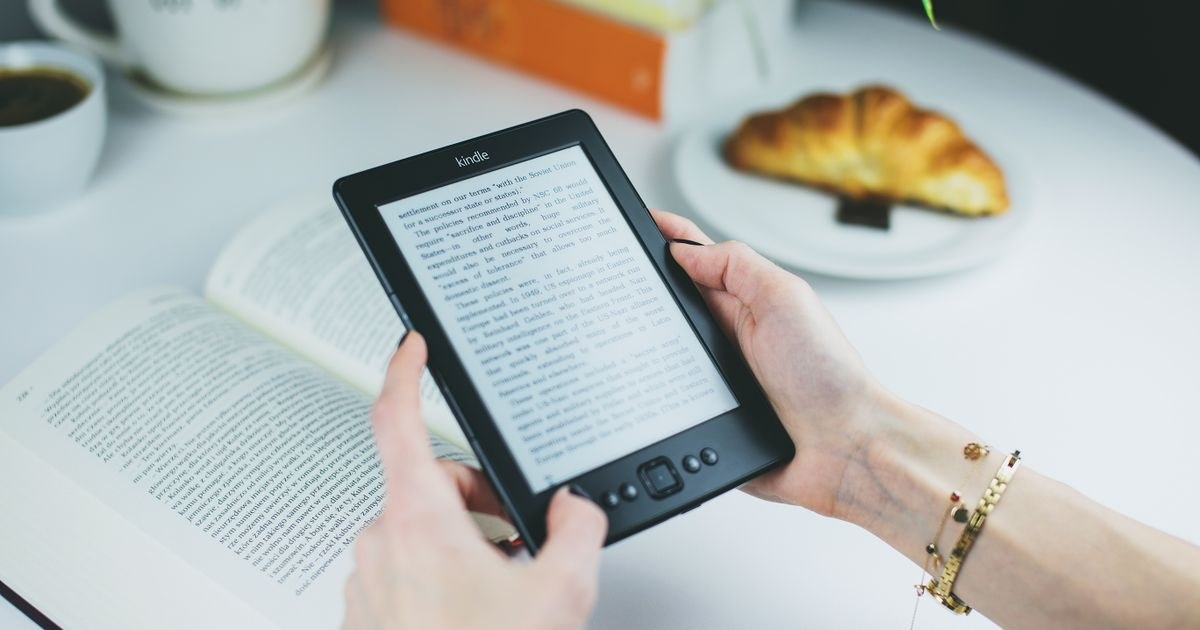
The honest answer to whether ebooks or physical books are better is that the question is too big to have one answer, and anyone who gives you one is selling something. The two formats are better at different jobs. Print holds real advantages in comprehension for long and difficult texts, in memory for where things are in a book, in sharing, lending, and keeping. Ebooks hold real advantages in travel, accessibility, instant acquisition, dictionary support, and sheer storage. This page goes through the evidence and the practical trade offs job by job, and ends with a decision method most readers actually need: not a verdict for all books, but a rule for choosing the format per book, which is how experienced readers quietly live already.
What the comprehension research actually says
The most studied question is whether people understand less on screens, and the fairest summary of the evidence is: slightly, sometimes, and it depends on the text and the clock. A 2018 meta analysis by Delgado and colleagues, pooling dozens of studies, found a small but consistent print advantage for comprehension, concentrated in informational texts and stronger when reading time was limited. Narrative reading shows smaller or vanishing differences in most studies. Several mechanisms are suspected: screens encourage a skimming posture that readers carry into deep texts, scrolling weakens the spatial memory of where a passage lives in a book, and the device itself imports distraction. None of this makes ebooks bad for comprehension in ordinary life. It makes print the safer tool for the specific job of studying a dense text under pressure, which is why the decision table further down splits by purpose rather than declaring a champion.
Memory, navigation, and the geography of a book
Ask a print reader where a favourite passage is and she will often answer spatially: near the end, left hand page, about a third down. Physical books give memory a map, fixed locations, thickness accumulating in the left hand, and readers navigate and remember by that geography more than they realize. Ebooks trade the map for tools: search that finds any phrase instantly, bookmarks and highlights that sync across devices, and a dictionary one tap away. For rereading, quoting, and working with a text, the ebook's tools are objectively superior. For absorbing a long argument's shape, the print map quietly helps. Students should know this trade exists, because it explains why a novel flies by on a reader while a textbook chapter studied on the same device feels oddly slippery afterward.
| Job | Better format | Why |
|---|
| Studying dense material for an exam | Print | Small comprehension edge, spatial memory, fewer distractions |
| Travel and commuting | Ebook | A library in a pocket, readable in the dark, nothing to lose |
| Reading in bed | Ebook, usually | Backlight, one hand, no lamp disturbing a partner |
| Building a child's reading life | Print | Shared attention, visible books, no device negotiations |
| Accessibility needs | Ebook | Resizable type, text to speech, weight, dictionary support |
| Lending and sharing | Print | Hand it over; no accounts, licences, or compatibility |
| Keeping for decades | Print | No format risk, no store dependency, survives neglect |
| Buying at midnight, urgently | Ebook | Instant delivery anywhere with a connection |
The case for ebooks, stated fairly
Ebooks win entire categories outright. Travel is the clearest: a long trip's reading, once a suitcase negotiation, is now a device that also holds the guidebook. Accessibility is the most important: resizable fonts, adjustable spacing, text to speech, and a device lighter than most paperbacks make ebooks the first format in history that adapts itself to the reader's eyes, hands, and ears, and for many readers with low vision or arthritis that is not a convenience but the difference between reading and not reading. Acquisition is instant and often cheaper, samples are free, and public domain classics cost nothing at all. Storage is effectively infinite, which matters in small homes. And the built in dictionary and search quietly raise comprehension for readers tackling texts above their comfort level, because the cost of checking a word falls to one tap.
The case for print, stated fairly
Print wins on ownership, first of all. An ebook is usually a licence to read, revocable in ways a physical book is not; a print book is yours to keep, lend, resell, annotate in the margins, and hand to a grandchild. Print wins on shared life: a book on a shelf advertises itself to everyone in the house, gets picked up by children and guests, and can be given away in a way that transfers the recommendation with it. Print wins on attention: a book contains only the book, while most ebook reading happens one notification away from everything else, dedicated e-readers excepted. Print wins on endurance: it needs no battery, no account, no store still existing in twenty years, and it survives drops, sand, and bathtubs better than its reputation suggests. And for children, print wins on the evidence of shared reading practice: a physical book holds a child's and an adult's attention in the same place, with pages a small hand can turn, which is why picture books remain stubbornly, correctly, physical.
Cost, environment, and other honest complications
Cost depends on volume. A dedicated e-reader pays for itself for a heavy reader buying new releases at ebook prices, and never pays for itself for a light reader whose books come from the library and charity shops, where print is nearly free. Environment cuts both ways as well: an e-reader carries a manufacturing footprint that must be spread across many books to beat paper, while a print book read once and landfilled is hard to defend; the greenest book, as usual, is the borrowed one, in either format. Children's screen time rules complicate the ebook case at home even when the reading itself is wholesome, because the device that holds the book also holds everything else, one more reason dedicated readers and print dominate family practice. And some books are objects as much as texts, art books, atlases, cookbooks built for a counter, editions kept for beauty, where the format question answers itself.
A decision rule that works in real life
Choose per book, by job, in about ten seconds. Ask what the book is for. If it must be studied, remembered structurally, shared, kept, or read with a child, default to print. If it must travel, be searched, be read in the dark, be enlarged, or be in your hands tonight, default to ebook. Let price break ties, and let the library override everything, since the borrowed format beats the bought one for any book you will read once. Most committed readers end up hybrid on exactly these lines, print for the shelf and the study desk, digital for the bag and the bedside, and they stop experiencing the choice as a loyalty test. The formats are not teams. They are tools, and the reader who owns both, and chooses deliberately, reads more than the partisan of either. If you take one sentence from this page, take the rule rather than a verdict: match the format to the job, and let the book in front of you, not a general loyalty, make the call.
The third format: where audiobooks fit
Any honest comparison now has to seat a third chair. Audiobooks are ebooks' sibling and print's opposite in one specific way: they free the eyes and hands entirely, which makes them the only format that fits driving, cooking, walking, and exercise, the hours when modern adults actually have time. For narrative, comprehension in listening runs close to reading for most adults, and a great narrator adds interpretation a silent page cannot. For dense study material, audio is the weakest format, because review, rereading, and spatial memory all but disappear, and the listener cannot slow the stream without fighting the medium. The hybrid pattern many readers settle into is print or ebook for the desk, audio for the road, sometimes the same book in both, with synced progress carrying the story between car and chair. Counted as reading by any reasonable standard, audio is best understood not as a rival to the two formats on this page but as the one that rescues the hours neither of them can reach.
Notes, highlights, and the working reader
Readers who work with text, students, writers, researchers, anyone preparing to teach or argue from a book, should weigh the annotation question separately, because here the formats diverge sharply. Print annotation is freeform and permanent: underlining, marginal argument, dog ears, sticky notes in a private language, all surviving in the physical object and visible at a glance across an open spread. Its weakness is retrieval: finding one note in ten print books is archaeology. Ebook annotation is the reverse, structured, searchable, exportable, and synced, with every highlight retrievable in seconds across a whole library, at the price of living inside a platform's ecosystem and its export rules. A practical synthesis used by many working readers: read in whichever format suits the book, but keep the thinking in a personal notebook or notes file that no platform owns. The highlights are raw material; the notes are the asset, and assets should live where the reader controls them.
The social life of books: gifts, shelves, and serendipity
Formats also differ in what they do to the people around the reader. A print book can be inscribed, wrapped, and given, and the inscription outlasts the occasion in a way no digital gift note does; bookshelves in a home quietly introduce their owner to every guest, lend themselves to borrowing, and put reading on display for children as a normal adult activity. Ebooks are private by design, which some readers prize and which undeniably removes friction, judgment, and the cover's social signalling from reading altogether. Serendipity splits too: print browsing, in shops and libraries and other people's shelves, surfaces books no algorithm would have offered, while ebook stores surface books no local shop could stock. None of these social facts decides the format question alone. Together they explain why the debate refuses to die: the choice is not only about comprehension per page, but about what kind of reading life a household wants to live in public.
Accessibility: where the argument simply ends
One consideration outranks every preference on this page, because for many readers the format question is not a preference at all. Ebooks let a reader enlarge type beyond any large print edition, change fonts, widen line spacing, and turn text into speech, which makes them the first format in history that adapts itself to low vision, dyslexia, and a dozen other reading differences without a special order or a special shelf. Print answers with its own accessibility: no battery, no glare, no interface to learn, and pages a reader with limited hand strength can prop and turn with simple aids. The honest conclusion is that accessibility cuts across the debate rather than settling it for one side. Households should stock whichever format removes the barrier in front of the actual reader at their table, and treat every other argument in this article as what it is: a discussion among the fortunate.
Frequently asked questions
Do you remember less when you read ebooks?
Research finds a small print advantage for comprehension of longer informational texts, especially under time pressure, with little difference for stories. Print's spatial geography seems to aid memory. For most everyday reading the difference is modest; for exam study, print is the safer default.
Are ebooks cheaper than physical books?
Per book, often yes for new releases, and public domain classics are free. But a device has an upfront cost, library print is free, and secondhand print can undercut everything. Heavy buyers of new books save with ebooks; library and charity shop readers usually save with print.
Which is better for children?
Print, for shared reading and for building a visible reading culture at home. Physical books hold joint attention, survive small hands, and sit on shelves advertising themselves. Ebooks earn a place for travel and for older children reading independently. The deciding detail is the device: a story on a dedicated reader or a printed page belongs entirely to the child, while a story on a multipurpose tablet shares its home with games and videos, and the negotiation that follows costs more reading than the format question ever will.
Which format is better for the environment?
It depends on volume and habits. An e-reader's footprint is repaid only across many books, while a print book read once and discarded wastes its own. Borrowed books in either format, library print or library ebooks, beat both purchases.
Should I buy a dedicated e-reader or use my phone?
A dedicated e-reader wins on battery, glare, weight, and the absence of notifications, which is most of what makes ebook reading feel shallow on a phone. If your ebook reading is occasional, the phone is fine; if it is daily, the dedicated device changes the experience. A useful trial: borrow a reader or use a tablet in airplane mode for one full book, and notice whether your sessions lengthen; for most people they do, because the single purpose device removes the small tax every chapter was paying to the rest of the internet.