Your twenties hand you a stack of firsts all at once: a first job that actually matters, a first lease, a first serious relationship, a first bank balance that has to survive the month. The thirteen books on this list were picked for that exact terrain. Some are novels that tell the truth about becoming an adult. Some are practical books about money, habits, and work that pay rent in your head for decades. Every page count below comes from the publisher of the edition named, so the reading plan built into this page runs on real numbers rather than guesses.
Read the list straight through, or use the tracker to check books off as you finish them and the calculator at the end to turn the whole shelf into a finish date.
How this list was built
Every title here had to pass three tests. First, it had to speak to a problem the decade actually poses: earning, saving, focusing, loving, grieving, or deciding. Books that are merely famous were cut, however good their reviews look. Second, it had to hold up on rereading, because a book you read at twenty two and again at twenty nine is worth three books you read once. Third, it had to be available in a current edition from a mainstream publisher, so the page counts in the table could be verified against the publisher's own records and a reader could find a copy at any library or bookshop. The result tilts recent, with eleven of the thirteen published after 2010, and keeps two older anchors, Siddhartha from 1922 and the long shadow of postwar reading habits that The Defining Decade argues against. Genres are mixed on purpose: four novels of adult life, three novels of the strange, four practical books, one memoir of building a company, and one book of advice letters. A decade is not one genre either. Two kinds of book were deliberately left off, however strong their reputations. Campus novels set in elite universities were cut for redundancy, because Normal People already does that work with more honesty. And the shelf holds no pure productivity manuals beyond Clear and Newport, on the theory that a reader who finishes those two owns the useful core of the genre and gains little from a third variation on it.
The thirteen books at a glance
Title
Author
Year
Pages
The Defining Decade
Meg Jay
2012
272
Siddhartha
Hermann Hesse
1922
176
Normal People
Sally Rooney
2018
288
The Psychology of Money
Morgan Housel
2020
256
Atomic Habits
James Clear
2018
320
Deep Work
Cal Newport
2016
304
Shoe Dog
Phil Knight
2016
400
Everything I Know About Love
Dolly Alderton
2018
368
Tiny Beautiful Things
Cheryl Strayed
2012
368
A Little Life
Hanya Yanagihara
2015
736
Piranesi
Susanna Clarke
2020
272
Klara and the Sun
Kazuo Ishiguro
2021
320
The Midnight Library
Matt Haig
2020
304
Page counts are the publishers' counts for these editions: Grand Central for The Defining Decade, Penguin Classics for Siddhartha, Crown for Normal People, Harriman House for The Psychology of Money, Avery for Atomic Habits, Grand Central for Deep Work, Scribner for Shoe Dog, Harper for Everything I Know About Love, Vintage for Tiny Beautiful Things, Doubleday for A Little Life, Bloomsbury for Piranesi, Knopf for Klara and the Sun, and Viking for The Midnight Library. Counts shift a little between hardcover and paperback printings, which is why the edition matters.
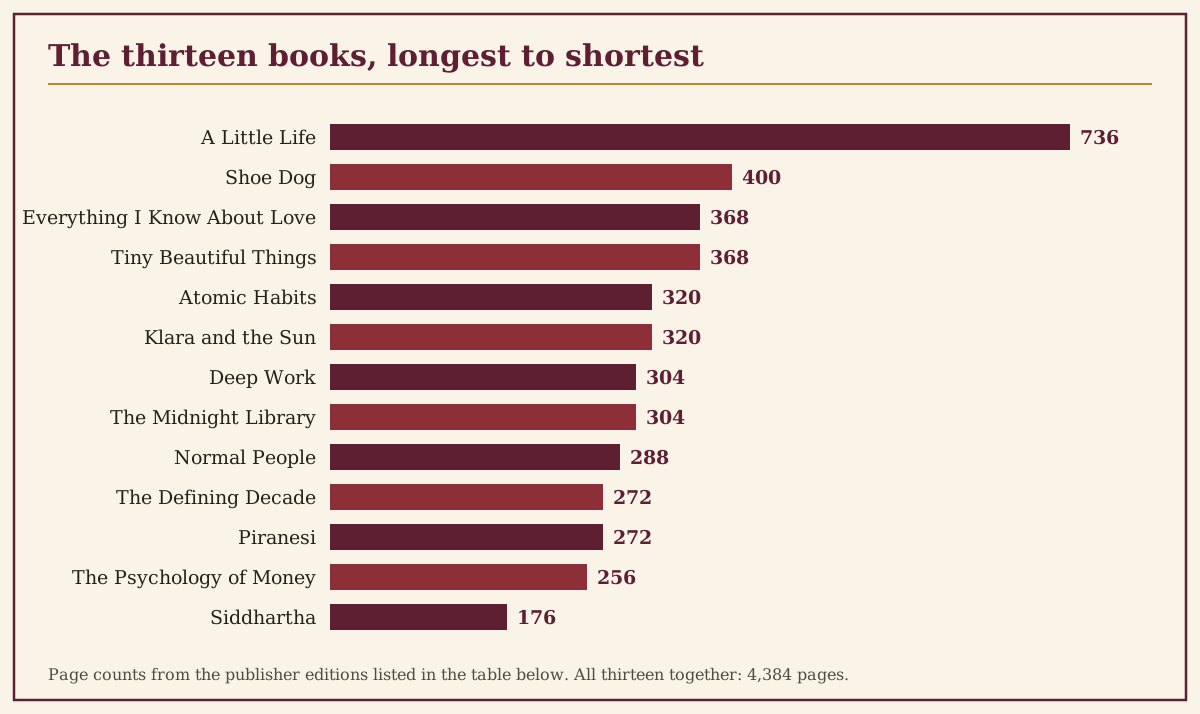
Bar chart of the thirteen books on this list ranked by page count, from A Little Life at 736 pages down to Siddhartha at 176
Interactive tool
The Twenties Reading List Tracker
Check off each step as you finish it. Your progress stays on this page.
0 of 13 complete
0% done
Money, work, and the shape of a career
The Psychology of Money by Morgan Housel (256 pages). Housel tells nineteen short stories about how people actually behave around money, and the lesson that survives every chapter is that wealth is mostly what you do not spend. A twenty something reader gets the compounding talk early enough for it to matter, wrapped in stories about janitors who died rich and lottery winners who did not. At 256 pages it is the fastest full read on this list after Siddhartha.
Atomic Habits by James Clear (320 pages). Clear argues that you do not rise to the level of your goals, you fall to the level of your systems, and then he shows how to build systems out of cues, cravings, responses, and rewards. The twenties are when your daily defaults get poured in concrete, so a book about changing defaults by one percent at a time lands harder at twenty four than at forty four.
Deep Work by Cal Newport (304 pages). Newport makes the case that the ability to focus without distraction is becoming rare and valuable at the same time. His four rules for cultivating concentration read like a career strategy for anyone whose first job involves a laptop, a phone, and a group chat that never sleeps.
Shoe Dog by Phil Knight (400 pages). Knight's memoir of building Nike out of borrowed money, missed payrolls, and a suitcase of Japanese running shoes is the most honest account of starting something that this list carries. It refuses the highlight reel. Year after year nearly ends the company, which is exactly the education a young founder or freelancer needs before the first bad quarter arrives.
The Defining Decade by Meg Jay (272 pages). Jay, a clinical psychologist, argues that your twenties are not a throwaway decade and that identity capital, weak ties, and deliberate choices about work and love compound quietly. The chapter on picking your family, and the one on the unthought known, have a way of rearranging how a reader plans the next five years.
Love, friendship, and the inner life
Normal People by Sally Rooney (288 pages). Connell and Marianne circle each other from school in Sligo to Trinity College Dublin, misreading every signal that matters. Rooney writes intimacy and class with almost no quotation marks and total precision, and readers in their twenties keep recognizing their own worst communication habits on the page.
Everything I Know About Love by Dolly Alderton (368 pages). Alderton's memoir moves from teenage MSN chats to flat shares and heartbreak in London, and its real subject is the friendships that carry a woman through her twenties. The recipes and the mock emails are funny; the chapters about her friend Farly are the ones people underline.
Tiny Beautiful Things by Cheryl Strayed (368 pages). Before the memoir Wild, Strayed wrote an anonymous advice column called Dear Sugar. This collection of those letters answers questions about grief, debt, leaving, staying, and starting over with a warmth that never turns soft. Keep it on the nightstand and read one letter at a time; it is built for the worst week of any year, not for a single sitting.
Siddhartha by Hermann Hesse (176 pages). A young Brahmin leaves home to find enlightenment and learns, river by river, that wisdom cannot be handed over as teaching. Hesse published it in 1922 and it remains the shortest book on this list and the one readers most often return to at thirty, forty, and sixty, hearing something new each time.
The big novels to live inside
A Little Life by Hanya Yanagihara (736 pages). Four friends move to New York after college, and the novel narrows, slowly and then completely, onto Jude, whose past the book reveals in layers. At 736 pages it is nearly a sixth of this entire list by itself, and it asks a real commitment: about 18.4 hours at a steady forty pages an hour. Readers who finish it tend to talk about it for months. Go in knowing it contains serious harm alongside extraordinary tenderness, and give yourself the option to stop.
Piranesi by Susanna Clarke (272 pages). Piranesi lives in a house of endless halls, tides, and statues, and keeps careful journals of its wonders. Clarke builds a mystery out of pure atmosphere, and the reveal reframes everything before it. It is the gentlest strange book here, a single weekend read that leaves the real world looking slightly enchanted.
Klara and the Sun by Kazuo Ishiguro (320 pages). Klara is an Artificial Friend who watches the world from a shop window and studies the Sun the way other narrators study God. Ishiguro tells a story about love, faith, and obsolescence through a voice that understands everything except the things that matter most, and the ending is quietly devastating.
The Midnight Library by Matt Haig (304 pages). Between life and death sits a library where every book is a life Nora Seed could have lived. Haig uses the premise to ask the question that defines the decade: what would actually have made it better? It is the most direct comfort read on the list, built for anyone convinced they chose the wrong door at twenty two.
What the whole list asks of your calendar
Add the table up and the shelf comes to 4,384 pages. That number is more useful than it looks, because it converts a vague ambition into arithmetic:
At forty pages an hour, an average adult pace for fiction, the full list takes 109.6 hours.
At twenty pages a day, which is roughly thirty minutes of reading at that pace, you finish in 219 days, comfortably inside eight months.
At fifteen pages a day the list stretches to about 292 days, still inside a single year.
The shortest book, Siddhartha at 176 pages, takes about 4.4 hours. The longest, A Little Life at 736 pages, takes about 18.4 hours, so plan it across a month of evenings rather than a weekend.
The honest trick is sequencing. Open with a short book to bank an early finish, alternate a novel with a practical book so neither habit starves, and save A Little Life for a stretch of life with no travel in it. The calculator below runs the same math on whatever pace you actually keep.
Interactive tool
How Long Will the Whole List Take?
The thirteen books on this list add up to 4,384 pages. Leave the page count as it is, set your own pace, and see the finish date for the full shelf.
109.6 hours of reading in total
At 30 minutes a day, this book takes about 220 days of reading sessions.
Start today and you finish on Monday, June 28, 2027.
Most adults read fiction at 30 to 50 pages an hour. Dense nonfiction often runs slower, closer to 20 to 30 pages an hour, and reading aloud to a child is slower still because the pictures and the questions are part of the book.
A sensible order to read them in
Start with The Psychology of Money, because it is short, story driven, and immediately useful. Follow with Siddhartha for the contrast: two books about what a life is for, arriving from opposite directions. Put Normal People third, while your patience for other people's mistakes is still generous. Work through Atomic Habits and Deep Work together in the middle of the list, when a routine is forming anyway. Give Shoe Dog and The Defining Decade to your most career anxious month. Save Everything I Know About Love and Tiny Beautiful Things for the season when your friendships are changing shape, because they will be. Close the list with the big novels in an order that builds weight: The Midnight Library first, then Piranesi and Klara and the Sun in either order, and A Little Life last, when your reading stamina is at its peak.
Decorative plate from the Reading Lists shelf of the Castroville Reading Guide catalogue
Reading the whole list without buying thirteen books
Thirteen hardcovers would strain a first apartment budget, so treat ownership as the exception. Every title on this list is a standard holding at public libraries, in print and usually as an ebook and audiobook on Libby, because all thirteen are current mainstream editions. Put holds on the long ones first: A Little Life and Shoe Dog gather waiting lists, while Siddhartha and The Psychology of Money turn over quickly. Used copies of the paperbacks are plentiful and cheap, since several of these were book club staples. Buy only the one or two you expect to reread and annotate; Tiny Beautiful Things and Atomic Habits are the usual keepers, one for bad weeks and one for working notes. If your library caps holds, stagger the requests a month apart so the queue delivers books at the pace you can actually read them, roughly one every two to three weeks on the twenty pages a day plan.
Frequently asked questions
How long does it take to read all thirteen books?
Together the books total 4,384 pages in the editions listed. At forty pages an hour that is 109.6 hours of reading. Spread over twenty pages a day it takes about 219 days; over fifteen pages a day, about 292 days. Your own pace will move the number, which is why the calculator on this page asks for your speed and your daily minutes instead of assuming them.
Which book should a twenty something read first?
The Psychology of Money is the easiest first finish: 256 pages, built from short stories, and useful the same week you read it. If you want a novel first, The Midnight Library is the gentlest entry point, and Siddhartha is the fastest, at 176 pages.
Is A Little Life appropriate for every reader in their twenties?
No. It is a serious, often harrowing novel about trauma and survival, even though it is also a novel about friendship and devotion. Read a detailed synopsis before you start, and treat stopping as a legitimate choice. The other twelve books will still be there.
Why do the page counts name specific editions?
Page counts are properties of editions, not of titles. A Little Life runs 736 pages in the Doubleday hardcover and 832 in the Vintage paperback, and The Defining Decade grew from 272 pages to 336 in its revised edition. This page names the edition behind every count so your reading plan matches the copy in your hand.
Can I swap in other books and keep the plan?
Yes, and the arithmetic travels with you. Replace any title with one of a similar length and the totals barely move. Swap a 300 page novel for a 600 page one and add about 7.5 hours at forty pages an hour. The tracker accepts whatever order you read in; only the finish line is fixed.
Are these books suitable for a book club of twenty somethings?
Most of them are. Normal People, The Midnight Library, and The Psychology of Money generate the liveliest disagreement per page. Tiny Beautiful Things works as a letter by letter club where each meeting takes two or three letters. A Little Life needs a committed group and a content conversation before the first meeting.
Does listening to the audiobook count as reading it?
It counts for the tracker, and for most of these books it changes less than purists claim. Memoir and advice, Shoe Dog and Tiny Beautiful Things above all, gain something from a human voice carrying the sentences. The practical books lose a little, since tables and chapter structure are harder to revisit by ear, and the novels with typographic tricks, Normal People with its missing quotation marks, read slightly differently in print. The page math on this page assumes eyes on paper; if you listen instead, trade the page count for the audio length and keep the same daily minutes habit.