A summer book has a specific job. It must survive being read in fragments, ten pages beside a pool, a chapter after dinner, a picture book at a picnic blanket's edge, and still hold together. It should be easy to enter and hard to leave, forgiving of interruptions, and warm in subject even when the plot turns serious. The twelve books below were chosen to that standard across a whole household: two picture books, four middle grade novels and graphic novels, three books for teens, and three for adults, so a family can read one list together and trade books across the summer.
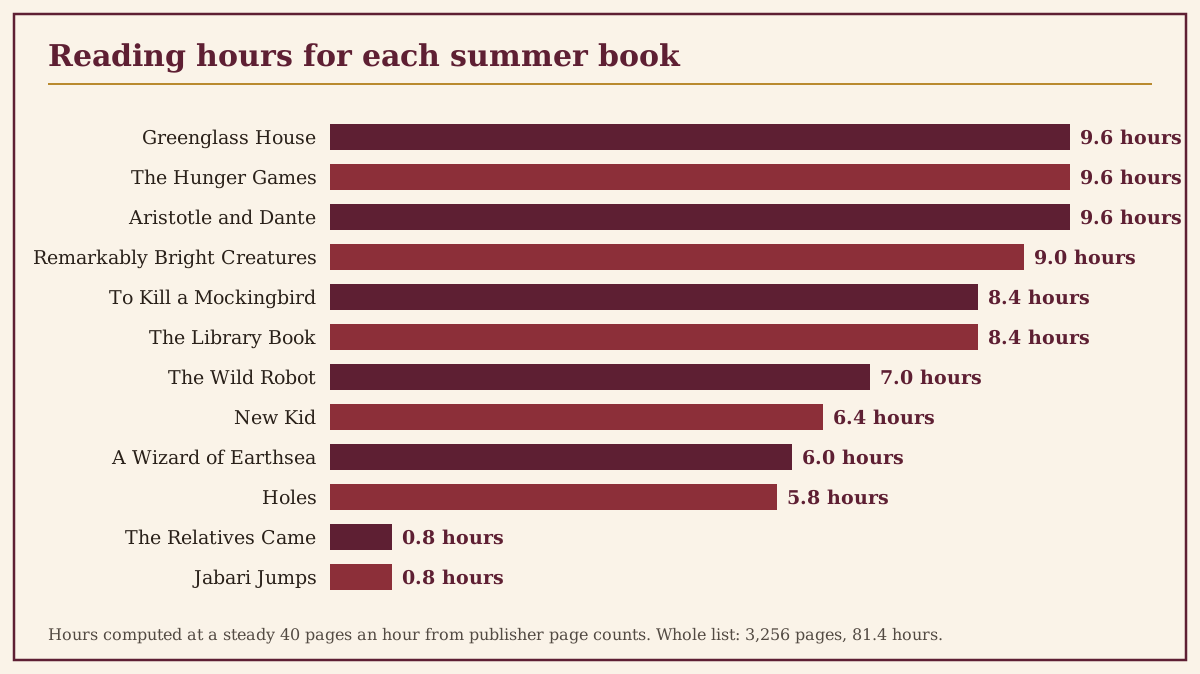
Every page count comes from the publisher of the edition named, and the hours column is computed from those counts at a steady forty pages an hour, a fair pace for an adult reading fiction and a generous one for a child. Treat the hours as planning numbers, not stopwatch readings.
The list, with the time each book asks for
Title
Author
Year
Pages
Hours at 40 pages an hour
The Relatives Came
Cynthia Rylant
1985
32
0.8
Jabari Jumps
Gaia Cornwall
2017
32
0.8
Holes
Louis Sachar
1998
233
5.8
The Wild Robot
Peter Brown
2016
279
7.0
Greenglass House
Kate Milford
2014
384
9.6
New Kid
Jerry Craft
2019
256
6.4
The Hunger Games
Suzanne Collins
2008
384
9.6
Aristotle and Dante Discover the Secrets of the Universe
Benjamin Alire Sáenz
2012
384
9.6
A Wizard of Earthsea
Ursula K. Le Guin
1968
240
6.0
Remarkably Bright Creatures
Shelby Van Pelt
2022
360
9.0
To Kill a Mockingbird
Harper Lee
1960
336
8.4
The Library Book
Susan Orlean
2018
336
8.4
Page counts are the publishers' counts: Atheneum for The Relatives Came, Candlewick Press for Jabari Jumps, Farrar, Straus and Giroux for Holes, Little, Brown for The Wild Robot, Clarion Books for Greenglass House, HarperCollins for New Kid, Scholastic Press for The Hunger Games, Simon and Schuster for Aristotle and Dante and for The Library Book, Clarion Books for A Wizard of Earthsea, Ecco for Remarkably Bright Creatures, and Harper Perennial for To Kill a Mockingbird. Hours are computed from those counts, as the column heading states, and rounded to one decimal place.
Interactive tool
Summer Reading Tracker
Check off each step as you finish it. Your progress stays on this page.
0 of 12 complete
0% done
Bar chart of computed reading hours for each book on the summer list at forty pages an hour
Picture books for slow evenings
The Relatives Came by Cynthia Rylant (32 pages). The relatives drive from Virginia in a station wagon that smells of gasoline and peppermints, and they stay, and stay, sleeping in every bed and chair while the house stretches to hold them. Stephen Gammell's loose, joyful drawings match the story's warmth. It is the definitive book about the best kind of summer visit, and it reads aloud in under ten minutes.
Jabari Jumps by Gaia Cornwall (32 pages). Jabari has passed his swim test and is definitely, absolutely ready for the high dive, until he climbs the ladder and looks down. His father's quiet strategy, take a breath and think about what surprises you like, gives children a script for every scary first that summer brings. Poolside reading does not get more on theme than this.
Middle grade: quest stories and one graphic novel
Holes by Louis Sachar (233 pages). Stanley Yelnats is sent to a desert camp where boys dig holes to build character, and three timelines braid themselves into one of the tightest plots in children's books. The chapters are short, the sentences are plain, and the machinery underneath is clockwork. It suits a reader meeting their first real novel structure, and it rereads beautifully for adults who missed it.
The Wild Robot by Peter Brown (279 pages). Robot Roz wakes up alone on an island and learns the language of animals to survive, then becomes mother to an orphaned gosling. The chapters are brief, many only a page or two, which makes the book kind to fragmented summer schedules, and the questions it raises about wildness and care give families something to argue about at dinner.
Greenglass House by Kate Milford (384 pages). A snowed in inn, a house full of guests with secrets, a stolen map, and a role playing game that unlocks the mystery: Milford sets a winter story here deliberately, because reading about deep snow in deep July is one of summer's private pleasures. At 384 pages it is the longest middle grade ask on the list, worth it for the reader who likes puzzles with their atmosphere.
New Kid by Jerry Craft (256 pages). Jordan Banks would rather go to art school; instead he starts seventh grade at a fancy private school where almost nobody looks like him. Craft's graphic novel is funny about code switching and sharp about belonging, and its 256 pages move at comic speed, an evening or two for most readers. It is the book on this list most often stolen by siblings.
Teens: three doors into longer fiction
The Hunger Games by Suzanne Collins (384 pages). Katniss Everdeen volunteers for a televised fight to the death in her sister's place, and the book has barely paused for breath since 2008. Its summer virtue is velocity: short scenes, cliff edges everywhere, and a heroine whose competence is the fantasy. Teens who claim not to read will finish it and ask for Catching Fire before the ice melts.
Aristotle and Dante Discover the Secrets of the Universe by Benjamin Alire Sáenz (384 pages). Two El Paso teenagers meet at a swimming pool in 1987 and become, slowly, the most important people in each other's lives. The chapters are short and the dialogue carries the weight; it is a quiet book to set against the Hunger Games noise, about fathers, silence, and learning to say what you feel. Best read slowly, a few chapters a night.
A Wizard of Earthsea by Ursula K. Le Guin (240 pages). A proud young wizard looses a shadow on the world and must sail to the edge of the map to face it. Le Guin's prose is the most beautiful on this list, spare and exact, and at 240 pages in the Clarion edition the book is a single long weekend. It suits the teen who wants fantasy with philosophy inside it and no wasted words.
Adults: warmth, a classic, and a love letter to libraries
Remarkably Bright Creatures by Shelby Van Pelt (360 pages). A widowed night cleaner at an aquarium and a giant Pacific octopus named Marcellus, who knows more about her missing son than anyone suspects, take turns narrating. It is gentle without being slight, structured like a mystery and paced like a friendship, and the Ecco hardcover's 360 pages pass faster than the number suggests.
To Kill a Mockingbird by Harper Lee (1960, 336 pages). Summer is when this book is set and when it reads best: Scout Finch's long hot seasons in Maycomb, the trial of Tom Robinson, and Atticus standing in the middle of it. The Harper Perennial paperback at 336 pages is the edition most readers will meet. If you last opened it in school, the adult reread is a different and better book, because Boo Radley's story lands differently once you have been a neighbor yourself.
The Library Book by Susan Orlean (336 pages). Orlean investigates the 1986 fire that nearly destroyed the Los Angeles Public Library and braids the case into a history of libraries and the people who run them. It is the natural closer for a summer list, a book about why the building that supplied all the others matters. Nonfiction readers get a true crime spine; everyone else gets a memoir of a reading life.
How the whole list fits into one summer
The twelve books total 3,256 pages, which computes to 81.4 hours at the stated pace. Nobody needs to read all of it; the list is a shelf for a household, and it splits into lanes. The children's lane, both picture books plus the four middle grade titles, runs 1,216 pages and about 30.4 hours. The teen lane runs 1,008 pages and about 25.2 hours. The adult lane runs 1,032 pages and about 25.8 hours. One reader doing one lane across a ninety day summer needs roughly twenty minutes a day, which is the entire secret of summer reading: the season is long, and small daily pages compound.
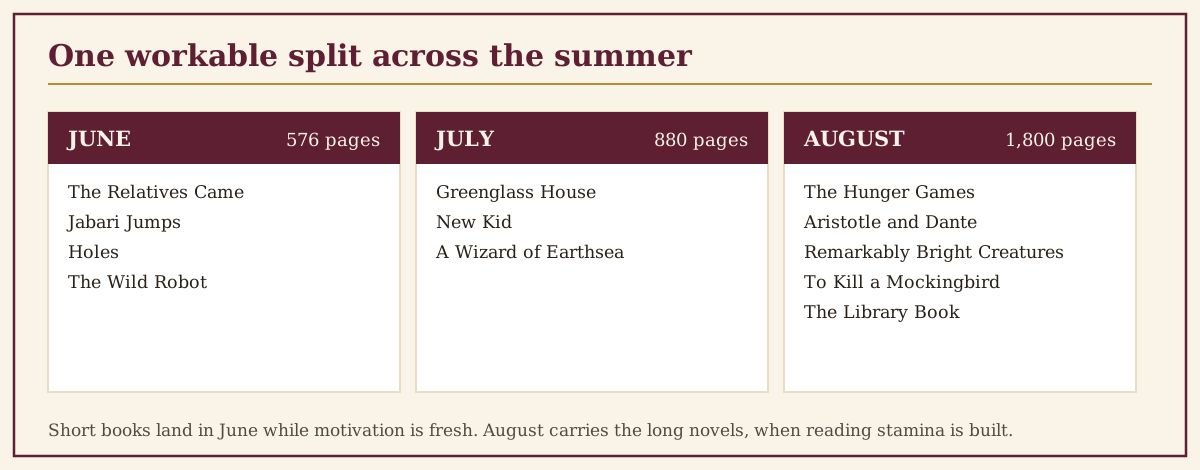
Diagram splitting the twelve books across June, July, and August with page totals for each month
Packing the list for travel
Books compete with swimsuits for suitcase space, so choose formats by leg of the trip. The picture books travel as library copies and come home again; they are read twenty times in a week and weigh almost nothing. For flights and long drives, one middle grade paperback per child beats a shared tablet, because Holes or The Wild Robot can be traded between siblings at the rest stop and nobody mourns a forgotten copy. Adults should pack the book they are least likely to finish at home, which on this list is usually To Kill a Mockingbird in its light Harper Perennial paperback, and leave The Library Book, all hardcover corners and 336 pages, for the porch at home. Photograph the tracker before departure; a phone picture of your progress survives even when the paper copy does not.
The rainy week protocol
Every summer produces a stretch of weather that cancels the pool, the trip, and the plan. Keep a reserve from the list for exactly those days instead of treating them as reading failures. Greenglass House was chosen partly as insurance: its snowbound inn turns a gray July week into atmosphere rather than interruption. New Kid and The Wild Robot serve the same role for younger readers, since both can be finished inside two wet afternoons and both reward a household reading together in one room. The practical move is to borrow the reserve books early and let them sit visibly on a shelf, so the rainy week feels like opening a present instead of serving a sentence.
One list, several readers: the household book trade
The list earns its keep when books move between readers. Set a simple trade rule for the season: anyone who finishes a book may press it on exactly one other person, with a two sentence pitch and no spoilers past the first chapter. The adult lane borrows downward more often than expected; Remarkably Bright Creatures has a long record of being claimed by teenagers after page forty, and The Library Book tends to migrate to whichever adult handles the library runs. Children borrow upward too, hearing Holes or Charlotte's Web read aloud years before they would open either alone. Mark trades on the tracker with a second check in a different pen if your household is the annotating kind. A book read twice by two people counts double in every way that matters, and the end of summer argument about which title traveled furthest is the real family reading prize.
If one ambitious reader does want the whole shelf, the split above keeps the load sane. June takes the two picture books and the two shortest novels while motivation is fresh, 576 pages. July takes the long middle grade puzzle, the graphic novel, and Earthsea, 880 pages. August, with reading stamina built and evenings still long, carries the five longest books, 1,800 pages. Run your own pace through the calculator and the finish date moves honestly with it.
Interactive tool
Finish the List Before School Starts
All twelve books together run 3,256 pages. Keep the page count, set the pace your household can actually hold, and the calculator returns the finish date to aim at.
81.4 hours of reading in total
At 30 minutes a day, this book takes about 163 days of reading sessions.
Start today and you finish on Sunday, May 2, 2027.
Most adults read fiction at 30 to 50 pages an hour. Dense nonfiction often runs slower, closer to 20 to 30 pages an hour, and reading aloud to a child is slower still because the pictures and the questions are part of the book.
Decorative plate from the Reading Lists shelf of the Castroville Reading Guide catalogue
Frequently asked questions
How many pages a day does the full list take?
All twelve books total 3,256 pages. Across a ninety day summer that is about 36 pages a day for a single reader attempting everything, and far less per person when a household splits the lanes: the children's lane averages about 14 pages a day, the teen lane about 11, and the adult lane about 11 to 12.
Are the reading hours in the table exact?
No, and the table does not pretend otherwise. Hours are computed at a flat forty pages an hour so the books can be compared with each other. A practiced adult may read Remarkably Bright Creatures faster and Earthsea slower, because Le Guin's sentences reward lingering. Use the calculator with your own measured pace for a personal estimate.
Which book should a reluctant teen start with?
The Hunger Games, without much contest. Its chapters end on hooks, its scenes are short, and its 384 pages move faster than any other long book here. New Kid is the alternative door for a teen who prefers images, and its success often leads back to prose within the same summer.
Can younger children share the middle grade books as read-alouds?
Yes, with two cautions. Holes and The Wild Robot read aloud well from about age seven, since their chapters are short and their sentences stay clear. Greenglass House is denser and better saved for confident listeners around ten. The Hunger Games belongs to teens; its violence is the point of its argument and lands differently read aloud to a small child.
What if we start the list in the middle of summer?
Start anyway and cut from the long end. Drop one August book, keep the picture books and your lane's shortest novel, and the plan still closes. A summer list is a menu with a tracker attached, not a syllabus with a final exam; finishing eight of twelve books is a good summer by any measure.
Why is a winter set book, Greenglass House, on a summer list?
Because contrast is a summer pleasure in its own right. Readers have always reached for snow in July, and the book's inn bound, lamp lit atmosphere is the opposite of a beach read in setting while matching it in momentum. The list already holds pools, relatives, and long evenings; one snowstorm balances the shelf.
How do we keep the habit alive when school starts again?
Shrink the dose instead of dropping it. The summer plan ran on roughly twenty minutes a day per lane; September can hold ten. Keep one list book in progress rather than starting a new shelf, protect the read-aloud slot by attaching it to an existing routine like breakfast or the drive, and let the tracker stay on the refrigerator until the last check lands. Households that finish the final book in October remember the list better than households that sprinted through it in July, because the ritual, not the deadline, was the point all along.