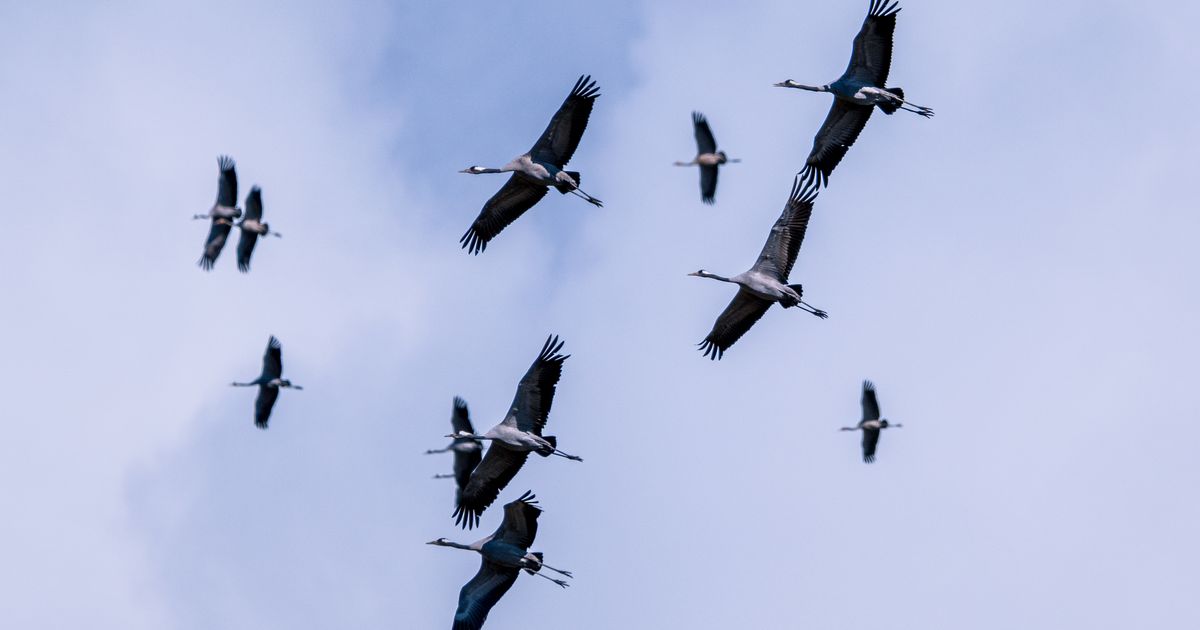
When the Cranes Fly South by Lisa Ridzen, translated from the Swedish by Alice Menzies, follows Bo, a former sawmill worker in his final months in rural northern Sweden, living alone with daily visits from a home care team and one great companion: his elkhound, Sixten. Bo's son Hans, with whom he has always had a rocky relationship, insists the dog must go, because Bo is too old to care for him. That threat cracks Bo's quiet open. His wife Fredrika, who has dementia and lives in a care home, no longer knows him, and Bo begins addressing his memories to Fredrika, taking stock of a life in which love was felt deeply and said rarely. The novel grew from the real notes a care team left for the author's family. This guide sequences the meeting in three movements: Sixten and autonomy, family and memory, and, in the marked spoiler movement, loss, forgiveness, and the last days.
Lisa Ridzén's debut was first published in Swedish by Forum in 2024, where it won the Swedish Book of the Year award and became a national bestseller; Alice Menzies's English translation appeared in 2025 from Doubleday in London and Vintage Books in New York, and the editions paginate differently, so this guide works by scenes rather than pages. Ridzén is a doctoral researcher in sociology studying masculinity in rural northern Sweden, and the novel's authority about old men, silence, and care work is professional as well as imaginative. A small correction worth making at the table: the author's name carries an accent, Ridzén, however your edition's cover chooses to print it.
How to Use This Guide
This quiet book needs a quiet room and a firm hand with time. The first movement covers Sixten, the care team's visits, and the fight over Bo's autonomy, and it is safe for readers through the opening third. The second movement follows the memories addressed to Fredrika, the father behind Bo, and the unsaid economy of the marriage, and it assumes the middle chapters. The final movement sits behind the spoiler marker and handles Ture's funeral, the reconciliation, and Bo's last days. Set one norm early: many members will be living some version of this story with a parent or a spouse, and the meeting discusses Bo's family, never the fitness of anyone at the table to judge their own.
Who's Who: A Refresher
Bo is the narrator, a nonagenarian former sawmill worker, proud, funny, and running out of time. Sixten is his elkhound, his closest companion. Hans is Bo's only child, now making decisions for his parents. Fredrika is Bo's wife, living with dementia in a care home, and the silent audience of his memories. Ture is Bo's best friend. Ingrid is the caregiver most sympathetic to Bo keeping Sixten. Lars-Erik is Bo's father, whose hardness Bo swore not to repeat.
| Person | Relation | Watch for |
|---|
| Bo | Narrator, former sawmill worker | Pride, tenderness |
| Sixten | His elkhound | Companionship, autonomy |
| Hans | Son, only child | Care, friction |
| Fredrika | Wife, in care | Absence, address |
| Ture | Best friend | Witness, humor |
| Ingrid | Caregiver | Advocacy, tact |
First Movement: Sixten and Autonomy
- Hans wants to take Sixten away for Bo's own good, and Bo hears the end of his independence in the proposal. Whose side did you take first, and did the book move you?
- Bo is angry at Hans for wanting control of his life, and in the same breath never wants him to let go. How does that contradiction run the whole novel?
- Bo accepts help from the caregivers, Ingrid especially, far more easily than from his own son. Why is a stranger's help bearable where a son's is not?
- The memory of Buster, Bo's first dog, colors everything about Sixten. How does an old loss set the terms of a present fight?
- Brief notes from the home care team open the sections, so readers know things Bo does not say. What do the notes add: tenderness, irony, or a second judgment?
Second Movement: Family, Memory, and the Unsaid
- Bo addresses his memories to Fredrika, who cannot receive them, in a marriage where the two were never people who talked a lot. What is left unsaid between people in this book, and is the silence Scandinavian or universal?
- Bo's father Lars-Erik made the decisions and was never questioned, and Bo never stood up to him the way Hans stands up to Bo. Where does Bo repeat his father, and where has he softened?
- Time and memory merge for Bo, so his first years with Fredrika feel closer than last week, while Fredrika has lost their whole life together. How does the book hold those two conditions together?
- Bo keeps Fredrika's scarf in a jar for its smell, and touch carries what words cannot. Which small object or sense carries the most in the novel for you?
- The seasons and the hay cutting mark the approach of autumn. How does the northern landscape pace a story about a life ending?
Third Movement: Loss, Forgiveness, and the Last Days (Spoilers)
Spoiler marker: everything past this line assumes the ending, so anyone protecting the last chapters should stop here and take the closing ritual instead.
- At Ture's funeral, Bo is offended to learn there were parts of his friend he never knew. Do we ever show our full selves, even to our closest friends?
- After Ture's death, something opens in Bo and he finds he cannot stay angry at Hans over Sixten. Why does grief accomplish what argument could not?
- The reconciliation between Bo and Hans is quiet rather than complete. Did it feel earned, and what remains permanently unsaid between them?
- Cranes in flight appear at key moments without explanation. What do they mean by the end, and does Bo die with dignity?
Closing Ritual
End with the gifting question the original draft of this guide proposed, sharpened. Ask each member to name the one person they would give this book to, and the one sentence they would write on the flyleaf, read aloud in under twenty seconds each. No debate follows anyone's choice. Ridzén's novel is about how much can be carried by very few words between people who love each other badly in the verbal sense, and a round of flyleaf sentences lets the room practice the book's own economy, saying the essential thing briefly, while there is still time to say it.
If Your Club Liked This One
A Man Called Ove by Fredrik Backman (2012). A widowed Swedish curmudgeon, a stray cat, and neighbors who dismantle his solitude against his will. It is the famous cousin of Ridzén's novel, funnier and broader, and comparing the two shows exactly how much quieter her book chooses to be.
Our Souls at Night by Kent Haruf (2015). Two widowed neighbors in a small Colorado town begin spending their nights talking, against the town's opinion. It pairs on late life tenderness conducted in few words, and this site's guide for it continues the conversation about what the old owe the watching world.
Remarkably Bright Creatures by Shelby Van Pelt (2022). A widower's grief, a night cleaner, and an octopus in a small town aquarium. Read it if your group responded most to Sixten, since both books understand that an animal can hold a place in a household that no human is permitted to fill.
Themes to Keep in Play
Autonomy as the last property. Bo's fight is not really about a dog; it is about who signs for his life. Whenever a scene turns on a small decision, meals, visits, walks, ask whose signature the book thinks it requires.
Silence as a native language. The men in this novel love in a dialect of acts, food left, wood stacked, a scarf kept for its smell. The group should practice translating that dialect rather than grading it, and notice when Hans begins, painfully, to learn it.
Care from strangers, judgment from kin. Bo accepts help from the care team that he cannot accept from his son, because the strangers' help carries no history. Keep that asymmetry in view; the reconciliation, when it comes, is built by changing what a son's help means.
Running the Meeting: Timing and Trouble Spots
Ninety minutes is right for this book; two hours will sag unless the room is full of caregivers with stories they have chosen to tell. Sixten and autonomy take twenty five minutes, family and memory thirty, a break, then thirty behind the spoiler marker, and ten for the flyleaf round. Trouble spots: first, the room will want to adjudicate Hans, and the novel is fairer to him than first readings admit; require his defenders to be heard before the funeral movement, since grief rearranges the verdict afterward. Second, dementia at the table is rarely theoretical; the pass rule applies to every question, and the leader should never ask a member to speak for Fredrika's condition from experience. Third, the ending's dignity question can turn into a debate about care policy; keep it inside Bo's household, where Ridzén deliberately kept it.
An Old Man, a Dog, and the Right to Decide, in One Paragraph for the Leader
Leaders should frame the novel as a negotiation conducted in a language neither party fully speaks. Hans argues in the modern dialect of risk assessments and capacity, which is accurate and lands as erasure. Bo answers in the older dialect of provision and endurance, which is dignified and lands as stubbornness. The care team's notes, interleaved through the book, are the translation layer, professionals recording a man they increasingly respect in the flat prose of a log, and their growing advocacy is the novel's quiet plot. Ture's friendship is the control case: a man who spoke Bo's dialect natively, whose death removes the last fluent speaker and forces the son's education. Put translation at the center and the reconciliation reads correctly, not as surrender by either man but as the first conversation in the book conducted, haltingly, in a shared language, which is why it does not need to be complete to be real.
Scene Anchors: Five Pages to Argue From
The proposal about Sixten. A son raises a practical concern and a father hears a death sentence for his independence. Anchor the autonomy argument here, where both translations of one sentence are audible.
The care notes. Flat professional entries open the sections and quietly contradict the family's account of decline. Keep them in evidence whenever capacity is debated; they are the book's most trusted documents.
The scarf in the jar. Bo keeps Fredrika's scent sealed against forgetting, his and hers. Use it when words fail the discussion, as they are meant to; the object is the argument.
Ture's funeral. Bo learns his oldest friend contained rooms he never entered. It is the hinge of the final movement and the right place to test what intimacy requires.
The cranes in flight. Birds cross the sky at the story's turning points without commentary. End the spoiler talk beneath them, asking what the novel gains by refusing to explain its own title image.
One Question for the Whole Evening
If one question must carry the evening, ask this: what does Bo still own, at the end, that no one can sign away? Let members build the inventory together, a dog, a house, a routine, a grievance, a scent in a jar, a friend's memory, and then ask which items on the list Hans would recognize as property at all. The two inventories, the father's and the son's, are the novel in cross section, and the distance between them is the exact size of the reconciliation the ending attempts.
More book club guides
Frequently asked questions
What is When the Cranes Fly South about?
Bo, a former sawmill worker in his late eighties in rural northern Sweden, lives alone with his elkhound Sixten and daily visits from a home care team. His son Hans believes Bo can no longer keep the dog, and that threat forces a reckoning between father and son, and between Bo and the wife, Fredrika, whose dementia has taken her memory of their life.
Is When the Cranes Fly South based on a true story?
The characters are fictional, but Ridzén has said the novel grew from the real notes a home care team left for her own family, and those notes inspired the care log entries that open the book's sections. Her academic research concerns masculinity in the rural Swedish north, the novel's exact territory.
When was When the Cranes Fly South published?
It was first published in Swedish in 2024 and won the Swedish Book of the Year award. Alice Menzies's English translation was published in 2025 by Doubleday in the United Kingdom and Vintage Books in the United States.
Does this guide spoil the ending of When the Cranes Fly South?
The autonomy and memory movements do not. Only the final movement, behind a clear spoiler marker, discusses Ture's funeral, the softening between Bo and Hans, and Bo's last days.
Is When the Cranes Fly South a good book club pick?
It is a beautiful one for groups ready for a quiet book about loud subjects: aging, fathers and sons, and who decides. Expect the room to divide over Hans more evenly than anyone predicts, which is the sign the novel is working.