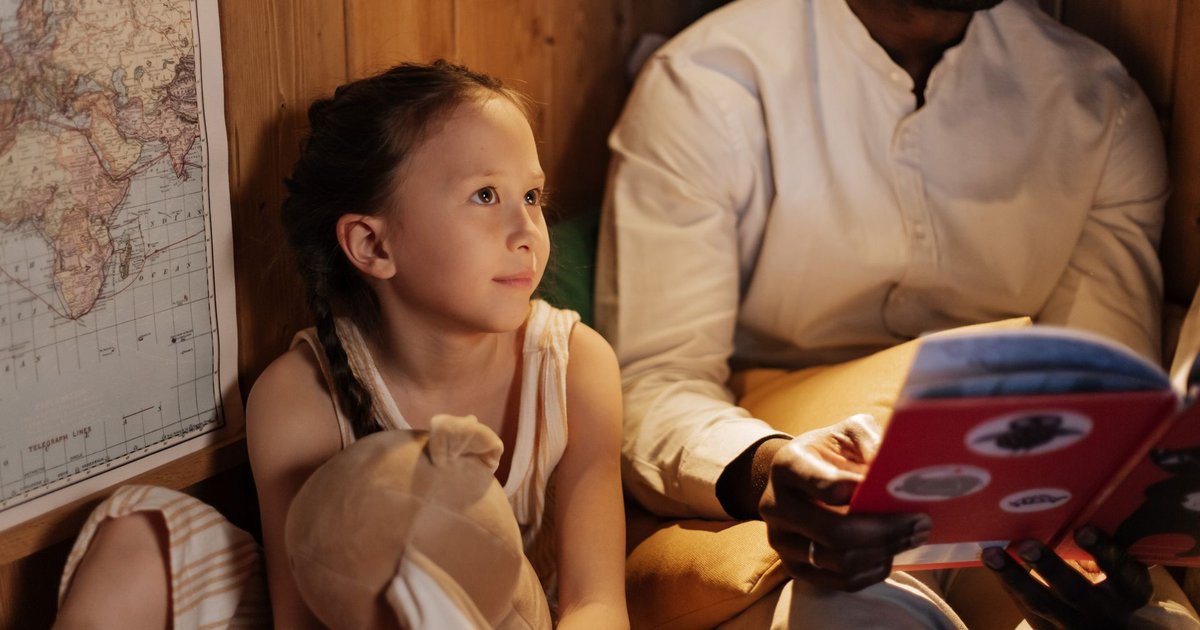
A story book earns its place on this list in front of a live audience. Read aloud performance is a stricter test than quiet reading: the book must hold a room of children who cannot see the words, through voice, suspense, repetition, and pictures worth staring at while the grown up turns the page. The thirteen books below are the ones that pass that test most reliably, gathered from library storytimes and family bedtimes alike. They are grouped by the job they do: the participatory books that get children shouting, the funny books, the story collections that carry a whole season of bedtimes, and the quiet closers that bring the energy down. Every book here has been read aloud by someone, many times, to children who asked for it again, which is the only review that matters in this category.
The participatory books: children do half the work
| Title | Author | Best for ages | Why it holds a room |
|---|
| The Book with No Pictures | B. J. Novak | 3 to 7 | The reader must say ridiculous things; children are helpless with power |
| Interrupting Chicken | David Ezra Stein | 4 to 8 | A chick who cannot let a story finish, and a papa who is running out of patience |
| We Don't Eat Our Classmates | Ryan T. Higgins | 3 to 6 | A young T. rex on the first day of school, with a problem of appetite |
| The True Story of the Three Little Pigs | Jon Scieszka | 5 to 9 | The wolf's side of the story, told like a courtroom defense |
The Book with No Pictures is the closest thing read aloud has to a magic trick: a book with only words, which force the adult to declare that they are a monkey, that their head is made of blueberry pizza, and worse, while children dissolve. Its genius is structural, the child understands the joke's engine instantly and demands encores to watch the adult suffer again. Interrupting Chicken works the opposite side of the same street, a little red chicken who bursts into every bedtime story to warn the characters, saving Hansel and Gretel and ruining the ending, until her papa turns the tables. We Don't Eat Our Classmates gives first day nerves to a small dinosaur who keeps eating her human classmates and spitting them out, appalled at herself, and children who are nervous about school laugh at the fear instead of carrying it. The True Story of the Three Little Pigs is the one for older listeners, Alexander T. Wolf explaining that it was all a sneeze and a cup of sugar, and it teaches, painlessly, that every story has a teller with an interest.
The funny books with heart
| Title | Author | Best for ages | Why it holds a room |
|---|
| Dragons Love Tacos | Adam Rubin | 3 to 7 | Dragons adore tacos and cannot survive spicy salsa; the catastrophe is total and delicious |
| The Day the Crayons Quit | Drew Daywalt | 4 to 8 | Letters of complaint from a box of crayons, each with a grievance and a voice |
Dragons Love Tacos runs on a single escalating rule, stated early and honored absolutely: tacos good, spicy salsa catastrophic. Children memorize the rule, wait for the party scene with the labeled buckets, and scream the warning the dragons cannot hear, which is participation of the highest order. The Day the Crayons Quit is a voices book: each crayon writes to Duncan with a complaint, Beige is tired of being called light brown, Orange and Yellow are not speaking over who colors the sun, and an adult who gives each letter its own voice and grievance will be asked for this book weekly. Both books reward a reader who commits. Read aloud is theater with one actor, and these are the scripts that make a shy adult look brilliant.
The story collections: a season in one binding
| Title | Author | Best for ages | Why it holds a room |
|---|
| Frog and Toad Storybook Treasury | Arnold Lobel | 3 to 7 | All the Frog and Toad stories in one volume, the funniest and kindest pages in children's literature |
| The Complete Tales of Winnie the Pooh | A. A. Milne | 4 to 8 | The full Pooh canon, 368 pages in the Dutton edition, enough for months of bedtimes |
| D'Aulaires' Book of Greek Myths | Ingri and Edgar Parin d'Aulaire | 6 to 10 | The Greek gods in gorgeous pictures and clear prose, the gateway mythology book |
Collections solve the bedtime problem of the empty shelf. The Frog and Toad treasury gathers every story Lobel wrote about the two friends, and its chapters are perfectly sized for one more story bargaining: short, complete, and funny in a way that deepens rather than wears out, with "The Letter" and "Cookies" as the traditional peaks. The Complete Tales of Winnie the Pooh, 368 pages in the Dutton edition, is the long project: two books' worth of stories whose wordplay rewards the adult reader as much as the child, and whose chapters can carry a family from the first night of summer to the first day of school. D'Aulaires' Book of Greek Myths is the collection for older children, the Olympian family dramas told straight and illustrated like a tapestry, and it starts more lifelong mythologies than any book in print. A household with these three volumes on the shelf is never without tonight's story.
The quiet closers
| Title | Author | Best for ages | Why it holds a room |
|---|
| Where the Wild Things Are | Maurice Sendak | 3 to 6 | Forty eight sentences, a wild rumpus, and the most perfect ending in picture books |
| The Rabbit Listened | Cori Doerrfeld | 3 to 7 | When a child's creation falls, every animal has advice; the rabbit just listens |
| Last Stop on Market Street | Matt de la Pena | 4 to 8 | A bus ride across a city, a grandmother's way of seeing, a perfect last page |
| Goodnight Moon | Margaret Wise Brown | 1 to 4 | The original closer: a room, a ritual, a voice dropping to a whisper |
Every read aloud session needs a last book, and the last book has a job: lower the heart rate, including the adult's. Where the Wild Things Are does it with rhythm, the wild rumpus burning off the day's energy in three wordless spreads before Max sails home to where someone loves him best of all, and his supper, still hot. The Rabbit Listened is the gentle book about big feelings: Taylor's tower falls, the animals arrive with fixes, and the rabbit simply stays, which makes it the story adults end up reading for themselves. Last Stop on Market Street closes with gratitude practiced as a way of seeing a city, and Goodnight Moon, the oldest book here, remains the closer of closers, a litany of goodnights that has been lowering eyelids since 1947. End with one of these and the session lands; end with Dragons Love Tacos and you have scheduled an encore instead.
Reading aloud well: the short craft
Three habits separate the read alouds children remember. First, preview the book once alone, so the voices, the page turn surprises, and the long sentences are not ambushes. Second, slow down below your instinct: children are building the pictures in their heads, and a beat of silence at a page turn is part of the story. Third, let them interrupt. Questions and predictions and corrections from the audience are not derailments; they are the comprehension happening out loud, and a child who predicts the salsa disaster is a child doing literary analysis. The books above forgive every skill level, which is why they are on the list: the text does the work, and the adult's job is mostly to show up, open the cover, and begin.
Building a home story shelf that lasts
A family that reads aloud for years ends up with a shelf that has a shape, and the shape is worth designing once. Keep one collection in reach for the long projects, Pooh or Frog and Toad, so a child can continue last night's story without a negotiation. Keep two or three participatory books at the front for the nights when energy is high and time is short, because those are the nights reading aloud gets skipped, and a guaranteed laugh is the best defense of the habit. Keep one closer visible, so the end of the session is never a search. Rotate one new library book a week through the pile to keep discovery alive, and let children shelve their own favorites spine out at their height, since a child who can choose tonight's book is a child invested in tonight's session. The shelf this list describes, thirteen books deep, is enough for years; everything after it is appetite, and appetite is the point.
Story books for occasions: the shelf beyond bedtime
The same books earn their keep outside the bedtime hour, and a family that knows it gets more from the thirteen. The participatory titles are the birthday party and classroom visit arsenal: a parent volunteer armed with The Book with No Pictures owns a room of second graders for fifteen minutes, guaranteed. Dragons Love Tacos is the sick day book, funny enough to work through a fever's misery and short enough for a hoarse adult. The collections are the travel shelf: the Pooh volume has carried families through train journeys and grandparents' houses for generations, because it is a month of stories in one object that fits a carry on. Greek myths are the long car ride champions for older children, one god's disaster per hour of highway. And the quiet closers double as the grief and change shelf, The Rabbit Listened above all, the book to reach for after a lost pet, a moved friend, a broken treasure, when a child needs company in a feeling before they need anything else at all.
When a child starts reading the story books alone
There is a bittersweet milestone hidden in this shelf: the day the child takes a favorite read aloud and reads it silently, alone, having memorized the route through it across a dozen shared readings. That day is the system working, not ending. Familiar books are the bridge every reader crosses into independence, because the known story carries the new skill of decoding. Keep reading aloud anyway, one level above what the child can manage alone, since the read aloud channel can carry richer language and longer stories for years after independent reading begins. The collections on this list are built for exactly that long overlap: Frog and Toad read to a four year old becomes Frog and Toad read by a seven year old, and Pooh read at six becomes Pooh reread, with new jokes landing, at ten. A family that keeps both channels open, theirs and yours, gets the full value of every book it owns, twice.
More recommendations
Frequently asked questions
What makes a story book good for reading aloud specifically?
Rhythm, repetition, and page turn suspense. A great read aloud sounds good in the mouth, gives children lines to join in with or events to predict, and places its surprises at page turns where the pause builds them. Illustrations matter differently too: they must read at arm's length to a small audience, not just delight a single lap reader.
How long should a read aloud session last?
For toddlers, five to ten minutes or one short book is a full session. For ages three to six, fifteen to twenty minutes, usually two or three picture books, matches attention. Older children happily take thirty minutes of a collection or a chapter book. End while they still want more; tomorrow's session is built by tonight's unsatisfied ending.
Which book on this list is best for a wiggly group?
The Book with No Pictures, because the wiggling becomes the show: children are laughing at the adult's forced silliness and policing the rules of the joke. We Don't Eat Our Classmates is the other group proof choice, short, physical, and built on a gag every child in the room can join. Save the quiet closers for the end, when the energy has somewhere to go, which is down.
Can I read these to mixed ages at once?
Yes, and this list is built for it. The participatory books play to the youngest while their structures amuse the oldest, Scieszka and Novak especially, whose jokes have a second level for eight year olds. Collections solve the mixed age problem nightly: one Frog and Toad story for the four year old, one Greek myth for the nine year old, same binding, same lap.
How many times should we reread the same book?
As many times as the child asks. Repetition is how young children learn story structure, vocabulary, and eventually the words themselves, and the fifth reading of a favorite is doing more developmental work than a first reading of something new. Adults survive repetition best with the books on this list whose language rewards the reader too, Milne and Lobel above all.