The fastest way to pick a disappointing children's book is to shop by the age printed on a retail listing. Ages are a starting point, but what a child needs from a book changes in kind, not just in difficulty: a two year old needs pages that survive chewing and pictures worth pointing at, a six year old needs a story that moves, and a ten year old needs a world large enough to disappear into. This guide is organized by those needs. Every pick below carries its publisher's page count for the edition named, because length is the fact parents actually plan around at bedtime.
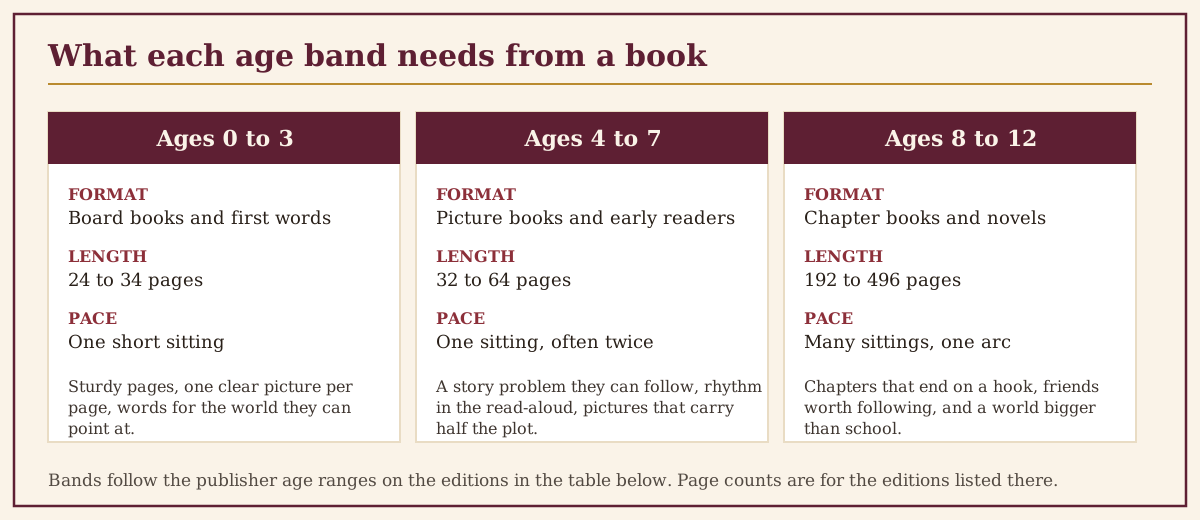
Chart of the three age bands, the formats that suit them, and what children in each band need from a book
The picks at a glance
Age band
Title
Author
Year
Pages
0 to 3
First 100 Words
Roger Priddy
2005
24
0 to 3
Goodnight Moon
Margaret Wise Brown
1947
34
0 to 3
The Very Hungry Caterpillar
Eric Carle
1969
26
0 to 3
Giraffes Can't Dance
Giles Andreae
1999
32
4 to 7
Where the Wild Things Are
Maurice Sendak
1963
48
4 to 7
The Day You Begin
Jacqueline Woodson
2018
32
4 to 7
Dragons Love Tacos
Adam Rubin
2012
40
4 to 7
Frog and Toad Are Friends
Arnold Lobel
1970
64
4 to 7
We Are in a Book!
Mo Willems
2010
64
8 to 12
Charlotte's Web
E. B. White
1952
192
8 to 12
Wonder
R. J. Palacio
2012
320
8 to 12
Smile
Raina Telgemeier
2010
224
8 to 12
Dog Man
Dav Pilkey
2016
240
8 to 12
The Lightning Thief
Rick Riordan
2005
377
8 to 12
The Mysterious Benedict Society
Trenton Lee Stewart
2007
496
Page counts come from the publishers of the editions listed: Priddy Books, HarperCollins, Penguin Young Readers, Scholastic, Simon and Schuster, Candlewick through Penguin Random House, Hyperion, Knopf, Graphix, Disney Hyperion, and Little, Brown. Board book counts describe the board editions; picture book counts describe the standard hardcovers.
Interactive tool
Read-Aloud Session Planner
Type in the page count of the book in your hand and how many minutes story time lasts in your house. The planner works out how many sessions the book will take at read-aloud speed.
0.7 hours of reading in total
At 20 minutes a day, this book takes about 3 days of reading sessions.
Start today and you finish on Monday, November 23, 2026.
Most adults read fiction at 30 to 50 pages an hour. Dense nonfiction often runs slower, closer to 20 to 30 pages an hour, and reading aloud to a child is slower still because the pictures and the questions are part of the book.
Ages 0 to 3: books that survive being loved hard
Children under three read with their hands and mouths as much as their eyes. They need board stock that wipes clean, one clear image per page, words attached to things they can point at in the room, and repetition strong enough that they can shout the last word of a line before you say it. Story barely matters yet; naming and rhythm are the curriculum.
First 100 Words by Roger Priddy (24 pages). Photographs of a banana, a ball, a dog, grouped by theme and labeled in big type. It is less a story than a tool, and toddlers treat it like one, carrying it around and quizzing adults. The padded board edition shrugs off drops and teething.
Goodnight Moon by Margaret Wise Brown (34 pages). A bunny says goodnight to everything in the great green room, and the ritual has been lowering heart rates since 1947. The alternating color and black and white spreads give tired eyes a rhythm to follow, and the whole book takes about four minutes, which is sometimes exactly the budget.
The Very Hungry Caterpillar by Eric Carle (26 pages). Carle's caterpillar eats through the week and teaches days, counting, and food names on the way to the butterfly ending every child sees coming and demands anyway. The die cut holes fit little fingers, and the board edition keeps them intact.
Giraffes Can't Dance by Giles Andreae (32 pages). Gerald the giraffe wants to dance and is laughed off the floor, until a cricket teaches him that the music differs for everyone. The rhymes bounce, the jungle scenes reward pointing, and the message lands without a lecture because Gerald finds his own tune rather than copying the warthogs.
Ages 4 to 7: stories with a problem and a pulse
Between four and seven, children graduate from naming the world to following events inside it. They need a character with a want, a complication, and an ending that pays the setup off, all inside one sitting. Read-aloud rhythm now matters enormously, because you are the audiobook. This is also the band where early readers appear: books a child can decode alone belong in the same stack as the picture books you still read together, pitched one level apart.
Where the Wild Things Are by Maurice Sendak (1963, 48 pages). Max sails to the wild things, becomes their king, and sails home to a supper that is still hot. Sendak trusted children with anger and homesickness in a text short enough to memorize, and the wordless wild rumpus pages let a young listener narrate for once.
The Day You Begin by Jacqueline Woodson (32 pages). Woodson writes about walking into a room where nobody shares your lunch, your language, or your summer, and about the moment you start telling your story anyway. Rafael López's illustrations fill doorways with light. It is the rare first day book that works for shy adults too.
Dragons Love Tacos by Adam Rubin (40 pages). Dragons adore tacos and cannot survive spicy salsa; the entire plot is a party invitation heading for disaster. The mock serious narration makes adults laugh while children track the simple cause and effect, and the sequel gives the stack a second night.
Frog and Toad Are Friends by Arnold Lobel (64 pages). Five short stories about two friends who fly kites badly, tell stories to cure hiccups, and celebrate each other. The chapters are true early reader length, the vocabulary is controlled without going flat, and the friendship is modeled at a level most adult novels never reach.
We Are in a Book! by Mo Willems (64 pages). Gerald and Piggie realize someone is reading them, panic about the book ending, and solve it in the way this whole band should: they ask to be read again. The speech bubble format doubles as a first lesson in how printed dialogue works, and two readers can take the two parts.
Ages 8 to 12: chapters, hooks, and worlds
Older children read for agency. They need protagonists who decide things, chapters that end mid problem, and books long enough to feel like territory. Series hooks matter because a finished book should point at the next one. Graphic novels belong in this band without apology; the panel grammar is its own literacy, and reluctant readers who stall on prose often fly through 240 pages of comics.
Charlotte's Web by E. B. White (192 pages). Wilbur the pig is saved by a spider who writes words in her web. White's sentences are the cleanest in children's literature, the farm logic is honest about death, and at 192 pages it is the classic first real novel to read aloud over a week of nights.
Wonder by R. J. Palacio (320 pages). Auggie Pullman, born with a facial difference, enters school for the first time in fifth grade, and the narration rotates through the people around him. The short chapters keep pages turning for readers who are not yet novel fit, and the book gives families a shared vocabulary for kindness that is specific rather than sentimental.
Smile by Raina Telgemeier (224 pages). A fall, two front teeth, and years of dental drama become a memoir about middle school friendship and embarrassment. Telgemeier's panels carry jokes in the backgrounds, and the book is a reliable bridge for readers moving from picture heavy reading toward longer work.
Dog Man by Dav Pilkey (240 pages). A cop with a dog's head fights crime in chapters drawn as a child's comic, complete with flip animations in the corners. Adults sometimes dismiss the deliberate misspellings and chaos; children read the 240 pages twice in a weekend. Volume one is the doorway to a long series.
The Lightning Thief by Rick Riordan (377 pages). Percy Jackson learns his absent father is a Greek god and gets blamed for stealing Zeus's lightning bolt. Riordan's chapters end on hooks with television discipline, and the mythology arrives as action rather than homework. First of five, and the rare series opener that fully earns its sequels.
The Mysterious Benedict Society by Trenton Lee Stewart (496 pages). Four gifted children answer a strange newspaper ad and end up spying on an institute that broadcasts mind controlling messages. At 496 pages it is the commitment pick of this band, dense with puzzles and codes, best handed to a reader who has finished everything else on this shelf and asked for a real one.
How long bedtime actually takes
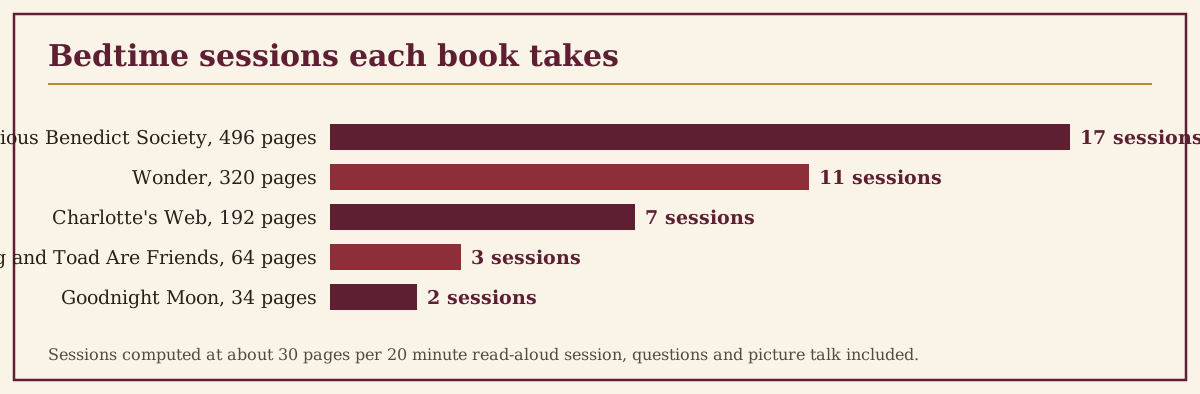
Page counts turn into plans once you know your household pace. Reading aloud runs far slower than silent reading, because the pictures need discussing and the questions are half the point. At roughly thirty pages per twenty minute session, the planner on this page estimates sessions for any book you type in, and the chart below runs the numbers for five picks from the table.
Bar chart of bedtime sessions needed for five books from the list, at twenty minutes a night
Notice the cliff between the bands. Everything in the youngest band ends inside two sessions. A middle grade novel is a week or three of nights, which is a feature when the ritual is the point and a problem when a library due date looms. Check a long book out with renewal room, or start it the week a holiday begins.
When a pick falls flat
Every household knows the scene: a carefully chosen book, three pages, a verdict of boring. Treat the flop as information. A child who rejects Wonder but devours Dog Man is telling you about format appetite, not about character. A child who abandons Charlotte's Web at chapter two may be objecting to the death soaked farm logic, or simply to sentences longer than their stamina. Ask one question, what was the worst part, and believe the answer enough to change one variable at a time: format first, then length, then subject.
Quitting a book is a reading skill, and modeling it calmly protects the habit better than any single title can. Set a house rule that any book may be abandoned after a fair trial, fifty pages for a novel, one full story for a collection, one sitting for a picture book, and keep a visible stack of finished books so progress has a shape. The abandoned book goes back to the library without ceremony. Some of today's rejects return as favorites a year later, when the band fits better; Frog and Toad has rescued more reading relationships than any lecture about perseverance.
Building the stack: one familiar, one new
A working home stack for any band holds three kinds of books at once. Keep one beloved reread in rotation, because repetition is how young children memorize language and how older ones comfort read. Add one book at the child's independent level, decodable and finishable without help. Then add one stretch book, read aloud or shared, pitched a level above solo skill. When a child stalls, the fix is usually a stack problem rather than a child problem: swap the stretch book down a band before you conclude that reading itself is the issue. The checklist below turns the choosing into a routine you can run standing in a library aisle.
Interactive tool
Age Band Picking Checklist
Check off each step as you finish it. Your progress stays on this page.
0 of 9 complete
0% done
Decorative plate from the Book Recommendations shelf of the Castroville Reading Guide catalogue
Frequently asked questions
How do I know which age band my child is really in?
Watch format tolerance, not birthdays. A child who sits for a 48 page picture book but fidgets through chapter one of a novel is still in the middle band for read-alouds, whatever their reading level at school. Bands describe the book a child can absorb happily, and most children live in two bands at once, one for listening and one for reading alone.
Are graphic novels like Dog Man and Smile real reading?
Yes. Reading a graphic novel requires decoding text, sequencing panels, inferring what happens in the gutters between frames, and tracking character expression, which is a full literacy workout. Dog Man runs 240 pages and Smile runs 224; a child who finishes either has sustained a novel length narrative.
What if my child only wants to reread the same book?
Rereading is the mechanism, not a failure of variety. Young children memorize a beloved book's language and begin matching print to speech, which is a genuine stage of learning to read. Keep offering new titles beside the favorite, one familiar and one new, and let the favorite keep its place.
How long should a read-aloud session last?
Twenty minutes is a sustainable default for the middle band, and five to ten minutes suits toddlers. The session should end while the child still wants more, not after attention collapses. At thirty pages per session, a 192 page novel like Charlotte's Web takes about seven nights.
Should I stop reading aloud once my child can read alone?
No. Children can listen at a higher level than they can decode, so read-alouds keep delivering vocabulary and story structures years beyond the point where solo reading starts. Many families keep a shared novel going through age twelve and beyond; the band table on this page assumes exactly that overlap.
What makes a good first chapter book after picture books?
Short chapters, generous white space, pictures that still appear every few pages, and a story problem sized for one sitting per chapter. Frog and Toad Are Friends at 64 pages is the gentlest bridge, and the Elephant and Piggie books teach dialogue reading before chapter books ask for it.