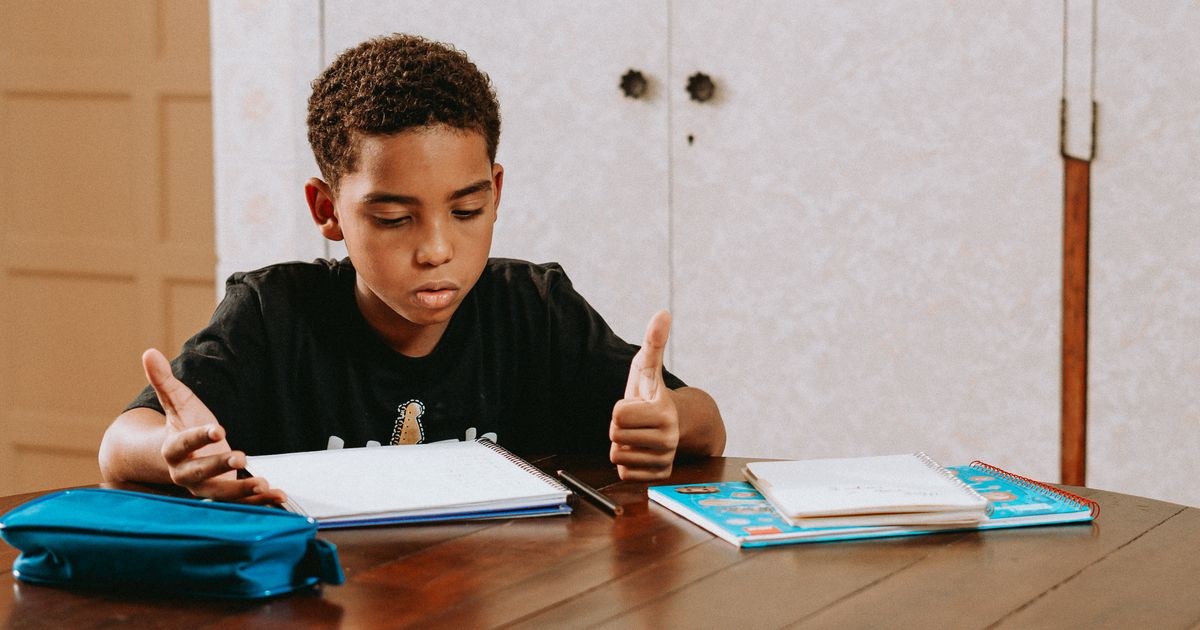
Reading comprehension is the skill underneath nearly every other school skill, and it stays underneath most adult ones too. A child can decode a page perfectly, every word pronounced, and still walk away with nothing, because decoding is only the delivery system. Comprehension is what the delivery was for: building meaning from print, connecting it to what is already known, noticing when it stops making sense, and doing something about it. This page explains why researchers and teachers treat comprehension as the main event of reading, what the science says it is made of, where it quietly governs school, work, and daily life, and how it grows, in children and in adults who think their reading years are behind them.
What comprehension actually is
The most durable account in reading science, the Simple View of Reading proposed by Gough and Tunmer in 1986, holds that reading comprehension is the product of two things: decoding, the ability to turn print into words, and language comprehension, the ability to understand those words once heard. Product matters in that sentence. If either factor is near zero, comprehension is near zero, which is why a fluent decoder with weak vocabulary stalls, and why a child with rich spoken language but shaky decoding does too. Comprehension itself is active construction. As a reader moves through a text, she builds a mental model of what it describes, links new information to old, fills gaps with inferences, tracks who did what and why, and continuously checks the model against the page. Skilled comprehenders do this monitoring automatically. Struggling ones often do not notice when meaning breaks down, which is why comprehension failure can look, deceptively, like carelessness.
The Matthew effect: why the gap widens
Keith Stanovich described reading's cruellest dynamic in 1986 and named it the Matthew effect, after the principle that the rich get richer. Children who comprehend well read more, because reading rewards them. Reading more builds vocabulary, background knowledge, and fluency, which make comprehension easier still. Children who comprehend poorly read less, because reading punishes them with confusion and effort, so their vocabulary and knowledge grow more slowly, and comprehension falls further behind, year after year, in every subject that runs on text, which is eventually all of them. The Matthew effect is the single strongest argument for treating comprehension as urgent early: the cost of waiting is not a static gap but a widening one, and the same dynamic, running kindly, is why small early investments in a child's comprehension compound like interest.
Comprehension is the gatekeeper of every subject
After the early grades, school stops teaching reading and starts assuming it. Mathematics arrives as word problems whose arithmetic is easy and whose language is the test. Science arrives as chapters and laboratory instructions. History arrives as documents. A student with weak comprehension therefore does not have a reading problem in one period of the day; she has a problem in every period, wearing different costumes, and her grades will describe it as weakness in subjects she may understand perfectly when they are explained aloud. This is also why comprehension predicts later educational outcomes so strongly: it is not one predictor among many, it is the medium the others are measured through. Adults assessing a struggling student should always ask the gatekeeper question first, whether the barrier is the subject itself or the text the subject is hiding behind.
Vocabulary and background knowledge: the fuel
Comprehension runs on two fuels that schools sometimes treat as extras. Vocabulary is the first: a reader who knows nearly every word on a page can spend her attention on meaning, while a reader meeting unknown words every line spends it on survival, and the model she builds has holes exactly where the unknown words were. Background knowledge is the second, and the more underestimated. A passage about baseball, a contract, or a cell is easy or hard in large part according to what the reader already knows about baseball, contracts, or cells, because knowledge supplies the inferences the text leaves out. This is why wide reading is not enrichment but infrastructure: every book, article, and documentary a reader finishes deposits knowledge that the next text will silently withdraw. It is also why comprehension can differ sharply between two texts for the same reader, a fact that baffles anyone who thinks of comprehension as a single fixed level.
| Component | What it does in comprehension | What weakens when it is missing |
|---|
| Decoding | Turns print into words accurately and automatically | Attention is consumed by the words themselves |
| Vocabulary | Supplies the meanings the text assumes | The mental model fills with gaps and guesses |
| Background knowledge | Provides the inferences the text leaves unstated | New information has nothing to attach to |
| Inference | Connects ideas across sentences and to prior knowledge | The reader recalls fragments instead of a whole |
| Monitoring | Detects when meaning has broken down | Confusion passes unnoticed and unrepaired |
| Working memory | Holds the thread while new information arrives | Long sentences and plots unravel midstream |
Comprehension at work and in adult life
Adulthood does not retire the skill; it raises the stakes and removes the teacher. Contracts, medical instructions, insurance documents, tax forms, workplace procedures, and the news all arrive as text whose misunderstanding has prices attached, financial, legal, and medical. The citizen's version is just as real: evaluating a claim, spotting the assumption inside an argument, and noticing when a statistic is being asked to carry more than it can are comprehension acts, performed on civic text. Digital reading adds its own demands, because online text arrives without the gatekeeping that print once supplied, and the reader must supply the skepticism personally: who wrote this, what would change their mind, what is the source under the claim. Adults who read widely and critically are not showing off a school skill preserved in amber. They are running the same machinery, on harder material, with nobody checking their work, which is precisely why the machinery deserves maintenance.
How comprehension grows
Comprehension grows the way it is used: by reading challenging text with support, in quantity, across kinds. Volume matters, because the fuels, vocabulary and knowledge, accumulate mainly through reading itself. Strategy instruction matters too, particularly the explicit teaching of moves like predicting, questioning, clarifying, and summarizing, which give readers repairs to apply when monitoring reports a breakdown. Discussion matters, because defending an interpretation against another reader's forces the mental model into the open where it can be corrected. For young children, the growth happens largely through ears before eyes: being read to, and talked with about books, builds the language comprehension half of the Simple View years before decoding arrives. For adults, growth looks like choosing harder books, reading against one's own views sometimes, and slowing down at the exact points where confusion begins, instead of speeding up to escape it, which is the instinct comprehension training exists to reverse.
A short self check for any reader
A reader, parent, or teacher can audit comprehension health with five questions, asked about a recent text. Could the reader say what it was about in two sentences of their own? Could they explain why the author included its most surprising part? Did they notice any point where they were confused, and can they name what they did about it? Did the text connect to anything they already knew, and did that connection help or mislead? Could they argue briefly against the text, or retell it for a different audience? Fluent yeses describe a comprehender at work. Hesitations locate the repair: summarizing practice for the first, discussion for the second, monitoring instruction for the third. The questions work at eight and at forty, which is the point of this whole page. Comprehension is not a stage of schooling to complete. It is the operating system of a literate life, and it rewards attention at every age it is given.
Comprehension in the screen age
The arrival of screens changed where reading happens more than what reading is. Research comparing print and screen comprehension, including a 2018 meta analysis by Delgado and colleagues across dozens of studies, finds a small but consistent advantage for print on longer informational texts, growing when reading is timed. The likely mechanism matters more than the effect size: screens train a shallower posture, skimming, scanning, clicking onward, and readers carry that posture into texts that require the opposite. The remedy is not nostalgia for paper. It is deliberateness: matching medium to task, slowing down on screen when the text is dense, and protecting some long form reading in every reader's week, in whichever medium they will actually sustain. What the screen age truly changed is the competition. Comprehension has always required sustained attention, and attention is now the most contested resource in a reader's day, which raises the value of the environments, routines, and habits that defend it.
What strong comprehension teaching looks like
Because comprehension is mostly invisible, it was long assumed to develop automatically once decoding was taught, an assumption the evidence does not support. Strong teaching makes the invisible visible. A teacher reads aloud and thinks aloud, narrating the predictions, questions, and repairs happening inside a skilled reader's head, so students can hear the machinery they are meant to build. Strategies are taught explicitly and one at a time, practised first with heavy support and then released to independence as students take over the moves. Texts are discussed, not merely answered about, with students defending interpretations from evidence. Vocabulary and knowledge are built deliberately, through wide reading and content rich teaching, because strategies without fuel are techniques with nothing to work on. And assessment asks for construction, retelling, explaining, arguing, rather than only recognition. None of this is exotic. It is simply teaching aimed at the product in the Simple View, both factors, on purpose, which is what the importance of comprehension finally demands: that it be treated as the point of reading, and taught like it.
Why comprehension is an equity issue
Comprehension's fuels are unevenly distributed long before school begins. Children raised amid books, conversation, and adults who read arrive with larger vocabularies and deeper background knowledge, and the Matthew effect then compounds the head start annually. Children without those advantages are not less capable; they are less fuelled, and the distinction matters because fuel can be supplied. Rich classroom talk, being read to daily, libraries within reach, and homes stocked with borrowed books are comprehension interventions precisely because they deliver vocabulary and knowledge to the readers who start with least. This is the deepest reason the skill belongs at the centre of education policy and family practice alike: comprehension is where advantage either compounds or gets interrupted, and every adult who reads with a child, stocks a classroom shelf, or funds a library is, whether they know it or not, working on the compounding.
Comprehension and the citizen
One more arena belongs on this page, because adults meet it daily and schools rarely name it: citizenship runs on comprehension. A ballot measure, a lease, a medical consent form, a news article arguing for a policy, each is a text whose meaning must be constructed, questioned, and connected to what the reader already knows, exactly as the Simple View and the components table describe. Citizens with strong comprehension notice when a headline outruns its evidence, when a statistic has no base, and when a speaker's conclusion does not follow from the facts offered; citizens without it are left choosing whom to trust, which is a weaker position than judging for oneself. This is why comprehension teaching is not merely an educational preference. It is the mechanism by which a population keeps its grip on its own decisions, and every reader built in childhood becomes a voter, patient, tenant, and juror whose understanding cannot be quietly managed by other people's summaries.
Frequently asked questions
What is the difference between reading and reading comprehension?
Reading includes decoding, turning print into words. Comprehension is the construction of meaning from those words: connecting ideas, inferring what is unstated, and monitoring whether it all makes sense. A reader can decode fluently and comprehend poorly.
Why do comprehension gaps widen over time?
Through the Matthew effect described by Stanovich: good comprehenders read more and so build the vocabulary and knowledge that make comprehension easier, while struggling readers read less and fall further behind in every text based subject.
Can comprehension be improved in older students and adults?
Yes. Strategy instruction, discussion, vocabulary growth, and large amounts of reading in challenging text all improve comprehension at any age. The machinery stays plastic; what changes with age is that the reader must supply the program personally.
How much does background knowledge really matter?
Enormously. Knowledge supplies the inferences texts leave unstated, so the same passage can be easy for a knowledgeable reader and hard for an equally skilled reader without the background. Wide reading is how the knowledge bank is built.
What is the fastest way to check a child's comprehension?
Ask for a retelling in their own words, then ask one why question about the text. Parroting sentences signals decoding without comprehension; a genuine retelling with a reasoned answer shows the model was built. Follow with the confusion question, did anything not make sense, because a reader who can point at the exact sentence where meaning broke is already monitoring, and monitoring is the habit on which every other repair depends.