An MLA book citation looks fussy until you see that it is built from a short list of parts that always arrive in the same order. The Modern Language Association calls those parts core elements, and a plain print book uses only four of them: author, title, publisher, and year. Learn where those four sit and how their punctuation works, and every harder case on this page, two authors, an editor, a later edition, a chapter, an ebook, becomes a small variation on a pattern you already know.
The basic template
For a book with one author, the works cited entry runs:
Last Name, First Name. Title of the Book in Title Case. Publisher, Year.
Filled in with a real example, it reads:
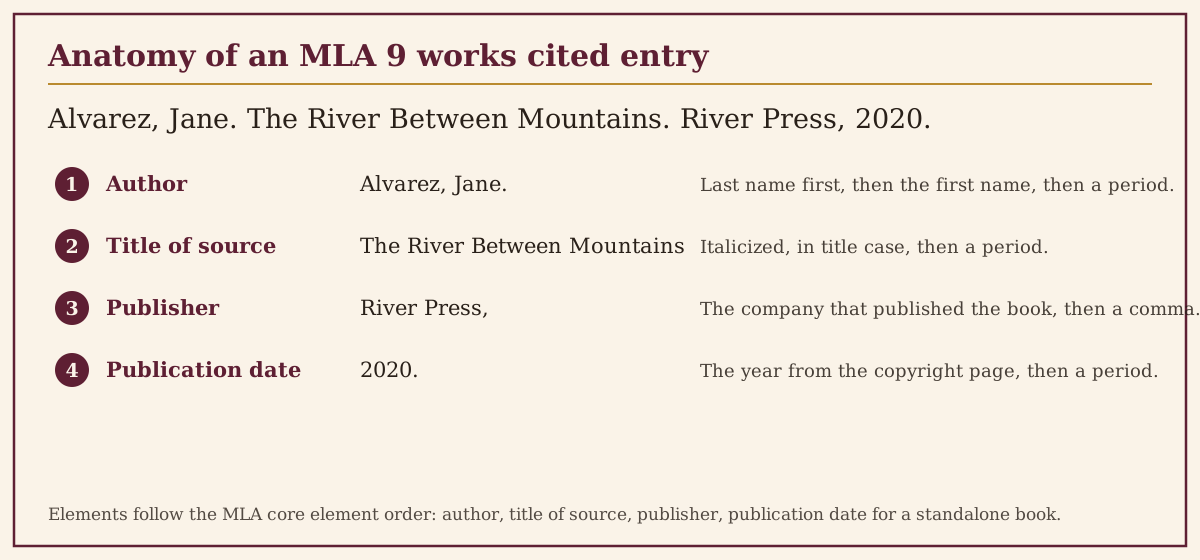
Alvarez, Jane. The River Between Mountains. River Press, 2020.
Four facts, four punctuation marks doing specific jobs. A period closes the author element. The title stands in italics with its own period. A comma separates publisher from year, and a final period ends the entry. Nothing in the entry is decorative; every mark tells the reader where one element stops and the next begins.
The nine core elements, in order
MLA builds every citation from the same nine slots. A standalone book leaves most of them empty, but knowing the full sequence explains why an editor lands after the title and why an edition statement sits where it does.
Order
Core element
What it holds for a book
Punctuation that follows
1
Author
The writer of the book, last name first
Period
2
Title of source
The book title, italicized, in title case
Period
3
Title of container
Empty for a standalone book; the anthology title when you cite one chapter
Comma
4
Other contributors
An editor or translator, introduced by a label such as edited by
Comma
5
Version
An edition statement, such as 2nd ed. or Ebook
Comma
6
Number
A volume number in a multivolume work, such as vol. 2
Comma
7
Publisher
The company that published the book
Comma
8
Publication date
The year printed on the copyright page
Comma, or a period when it ends the entry
9
Location
The page range of a chapter, written pp. 45-62
Period
Compiled from the core elements model published by the Modern Language Association on its style site, style.mla.org, and set out in the MLA Handbook, ninth edition. The punctuation column follows the handbook rule: elements one, two, and nine close with a period, and the elements between them are separated by commas.
Diagram labeling each part of a finished MLA works cited entry for a book, element by element
Build the entry with the citation tool
Reading a template is one thing; typing your own book into the pattern is faster. Enter the author, title, publisher, and year from your book's title page and copyright page, and the builder returns the finished works cited entry plus the in text citation that matches it. The optional fields cover the two variations students hit most, an editor and a later edition.
Interactive tool
Book Citation Builder
Type the details from the book title page and copyright page. The builder formats the full entry and the matching in-text citation in MLA 9 style as you type.
Works Cited entry
Alvarez, Jane. The River Between Mountains. River Press, 2020.
In-text citation
(Alvarez [page])
Leave the author blank and fill in the editor to cite an edited book by its editor. Add an edition number only when the title page names one; a first edition carries no edition statement in MLA.
Worked examples, case by case
One author
Alvarez, Jane. The River Between Mountains. River Press, 2020.
In text: the valley "remembers every road built across it" (Alvarez 112). The parenthetical carries the author's last name and the page, with no comma between them and no abbreviation before the number.
Two authors
Reverse the first author only, then join the names with the word and:
Nair, Priya, and Tom Okafor. Field Notes on Rivers. River Press, 2021.
In text, name both writers: the survey method is described as "slow looking" (Nair and Okafor 88). Because both names fit comfortably, MLA keeps both in the citation rather than shortening the reference.
Three or more authors
List the first author and let et al. stand in for the rest:
Osei, Kwame, et al. Reading the Watershed. Cambridge UP, 2019.
Two details matter here. Et al. is Latin for "and others," and it takes a period after al. only. And a university press shortens in MLA: the words University Press become UP, so Cambridge University Press prints as Cambridge UP. In text the same shortening applies: (Osei et al. 203).
A book with an editor instead of an author
Anthologies and collections often have no single author. The editor then takes the author slot, with a label after the name:
Brennan, Cole, editor. Stories of the Valley: An Anthology. River Press, 2018.
The label is part of the element, so it sits inside the author segment before the period. Cite the book in text by the editor's name: (Brennan 45).
A later edition
When the title page names an edition, that statement takes the version slot, right after the title:
Alvarez, Jane. The River Between Mountains. 2nd ed., River Press, 2023.
A first edition gets no statement at all; silence is how MLA says the book is the original printing. In text nothing changes, because the citation still points at the author and the page: (Alvarez 112). Check the page number against the edition you actually read, since repagination between editions is common.
A chapter in an edited book
Citing one chapter means citing two titles: the chapter, in quotation marks, and the book that contains it, in italics. The container slot finally earns its keep:
Okafor, Tom. "The Mill at Cedar Crossing." Stories of the Valley: An Anthology, edited by Cole Brennan, River Press, 2018, pp. 45-62.
The location slot closes the entry with the chapter's page range, introduced by pp. In text, cite the chapter's author, not the book's editor: (Okafor 51).
An ebook
An ebook is cited like its print twin, with the format named in the version slot when your instructor or publisher wants it shown:
Alvarez, Jane. The River Between Mountains. Ebook, River Press, 2020.
If you read on a platform that repaginates, such as a phone app with scrolling text, your in text citation may have no stable page to point at. In that case cite the author alone, or the chapter number if the book provides one, rather than inventing a page.
Where the details come from: two pages of the book itself
Every fact in the entry lives in the front matter of the copy you read. The title page, usually the first printed page after the half title, gives the exact title, the author or editor as the publisher presents them, and the publisher's name. Turn it over and the copyright page gives the year, and it is this year, the year of the edition in your hand, that belongs in the citation, even when the work itself is far older. A 2002 Penguin Classics printing of Siddhartha is cited as 2002, because your page numbers come from that printing and a reader following your citation needs to land on the same pages.
The copyright page also settles arguments. It lists earlier editions, names the translator of record, and states whether your copy is a reprint. When a library catalog and the book disagree, the book wins; catalogs describe families of editions, while the citation describes one physical object. Photograph both pages before you return a borrowed book and you will never have to reconstruct a citation from memory at midnight.
The hanging indent, and why it exists
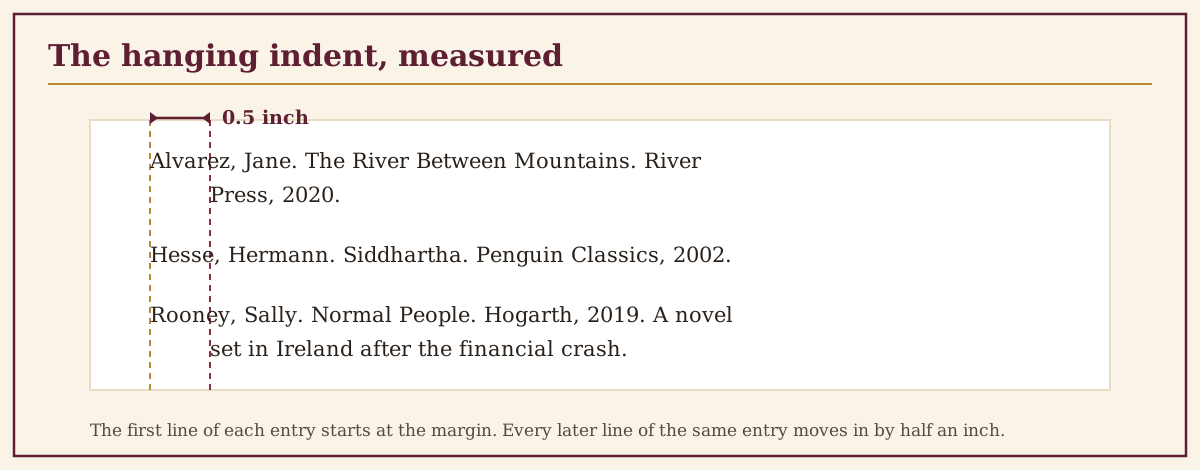
Every works cited entry that runs longer than one line uses a hanging indent: the first line begins at the left margin, and each following line of the same entry is indented half an inch. The shape is not decoration. It turns the list into a scanning tool, because a reader hunting for a name reads down the margin and finds every entry's first word standing proud of the block.
Diagram of a works cited page showing the half inch hanging indent measured from the margin
In Word, select the entries and open Paragraph settings, then choose Hanging under Special and set it to 0.5 inches. In Google Docs the same setting hides under Format, Align and indent, Indentation options. Never fake the shape with the space bar or by pressing Enter at the end of each line; both tricks collapse the moment the paper is opened on another machine or the font changes.
In text citations: the rules that cover most papers
Give the author's last name and the page number, nothing else: (Alvarez 112). No comma, no p., no pp. for a single page.
When the author's name already appears in your sentence, the parenthesis holds the page alone: Alvarez describes the valley as a ledger (112).
For a book with no author, shorten the title to its first few words and keep the italics or quotation marks the title would wear in the list: (River Between 112).
A quotation longer than four lines becomes a block quote, indented half an inch as a block, with the citation placed after the closing punctuation instead of before it.
Page ranges in the text shorten the second number to its changed digits: (Alvarez 112-14).
Mistakes that cost points
The errors graders circle are remarkably consistent. Students paste the title in sentence case because that is how it appeared in a catalog, when MLA wants title case with the major words capitalized. They add the city of publication, a habit left over from older styles that MLA dropped decades ago. They copy the date from an online listing instead of the copyright page, which is the date MLA trusts. They list every author of a five author book when et al. was required. And they alphabetize by first name because the entry was copied from a title page. Each of these is a ten second fix once you know the pattern, which is the entire argument for learning the pattern instead of memorizing single examples.
Reprints, classics, and older works
Books outlive their first editions, and MLA cites the edition consulted, with one graceful option for showing the work's age. When the history matters to your argument, you may add the original publication year at the very end of the entry, after the current details:
Hesse, Hermann. Siddhartha. Translated by Joachim Neugroschel, Penguin Classics, 2002.
A reader who wants to signal that the novel is a century old can close the entry with the original date placed after the publisher information for the edition used. Most undergraduate papers skip the flourish, and instructors accept either form when it is applied consistently. What is never optional is the year of the edition itself, because your quotations and page numbers belong to that printing and no other.
Facsimile reprints, where a publisher photographs an old edition page for page, are cited as the reprint they are, with the reprint publisher and year. The work's first publisher belongs in your prose if it matters, not inside the citation, which exists to send a reader to the object you held.
A volume from a multivolume set
The number slot wakes up when a work spans volumes. If you used one volume of a set, name that volume after the title and give the publication details of that volume:
Osei, Kwame, et al. Reading the Watershed. Vol. 2, Cambridge UP, 2021.
If you drew on two or more volumes, cite the set as a whole instead: give the total number of volumes after the title, as 3 vols., and the date range of the set. The reader needs to know which physical object you opened, and the volume number is the difference between a citation that resolves and one that wanders a library floor.
Before you hand the paper in, run the finished list against the check below. It covers the pattern level errors that spell checkers and citation generators both miss.
Interactive tool
Works Cited Pre-Submit Check
Check off each step as you finish it. Your progress stays on this page.
0 of 10 complete
0% done
Decorative plate from the Book Reports and Citations shelf of the Castroville Reading Guide catalogue
Frequently asked questions
Do I include the publisher city in an MLA book citation?
No. MLA dropped the place of publication from book citations in the eighth edition and the ninth keeps it out. The publisher's name and the year carry everything the reader needs to find the edition you used.
How do I cite a book with two authors in the works cited list?
Reverse the first author's name, add a comma, then give the second author in normal order, joined by the word and: Nair, Priya, and Tom Okafor. Only the first name is flipped, because the entry is alphabetized by that first surname.
What if the book has no author at all?
Begin the entry with the title, italicized, and alphabetize by the first major word of the title, ignoring A, An, or The. In the text, cite a shortened form of the title with the page: (River Between 112).
Does MLA want the book's ISBN in the citation?
No. The ISBN identifies a product, and MLA citations identify the work and the version you consulted. The core elements carry that information already, so the number stays out.
How is a translator credited in an MLA entry?
The translator is an "other contributor" and follows the title: Siddhartha. Translated by Joachim Neugroschel, Penguin Classics, 2002. The label comes first, then the name in normal order.
Should the works cited list be double spaced?
Yes. The whole paper, list included, is double spaced in MLA format, with no extra blank lines inserted between entries. The hanging indent and the spacing work together: entries read as separate blocks even though no gap separates them.