APA style runs on an author and date engine. Where some styles bury the year at the end of an entry, APA pulls it forward and sets it in parentheses right behind the author's name, because the fields that use it, psychology, education, nursing, and the social sciences, judge evidence partly by its age. A book reference in APA therefore has four parts that never change order: who wrote it, when it appeared, what it is called, and who published it. Everything else on this page, editors, editions, chapters, DOIs, is a controlled variation on those four parts.
The basic template
Last Name, Initials. (Year). Title of the book in sentence case. Publisher.
Worked on a sample book, the template becomes:
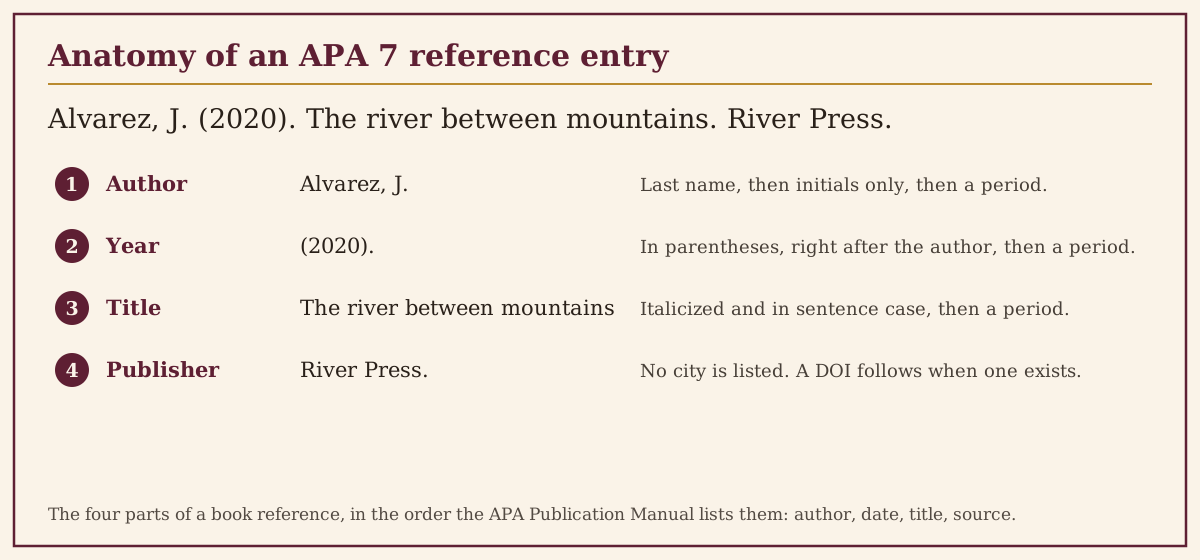
Alvarez, J. (2020). The river between mountains. River Press.
Notice what the format does to familiar things. The author's first name shrinks to an initial. The title loses its headline capitals and keeps only its first word, its first word after a colon, and its proper nouns in uppercase. The publisher stands alone with no city attached, a change APA made final in the seventh edition. Each choice is deliberate, and each is explained in the sections below.
The four parts of a book reference
Part
Format for a book
What to watch
Author
Last name, then initials, authors in title page order
An ampersand joins the final author; up to twenty authors are listed in full
Date
The year in parentheses, followed by a period
Use the copyright year of the edition you read
Title
The book title in sentence case and italics
An edition statement follows in parentheses and is not italicized
Source
The publisher's name, then a period
No city or state; a DOI, when the book has one, comes last as a link
Compiled from the book reference guidance and examples published by the American Psychological Association at apastyle.apa.org, the style hub for the Publication Manual, seventh edition.
Diagram labeling the author, year, title, and publisher inside a finished APA reference entry
Format your book with the citation builder
Set the style toggle to APA 7 and type the details from your book. The builder applies sentence case, swaps first names for initials, and returns the reference entry together with both in text forms, parenthetical and narrative, so you can see how the same source behaves inside a sentence and at the end of one.
Interactive tool
Book Citation Builder
Type the details from the book title page and copyright page. The builder formats the full entry and the matching in-text citation in APA 7 style as you type.
Reference list entry
Alvarez, J. (2020). The river between mountains. River Press.
Parenthetical in-text citation
(Alvarez, 2020, p. [page])
Narrative in-text citation
Alvarez (2020)
APA capitalizes only the first word of the title and the first word after a colon, plus proper nouns, so check the built entry for names of people and places. A whole book edited by someone else is still cited by its author; editors are named in chapter references instead.
Worked examples, case by case
One author
Alvarez, J. (2020). The river between mountains. River Press.
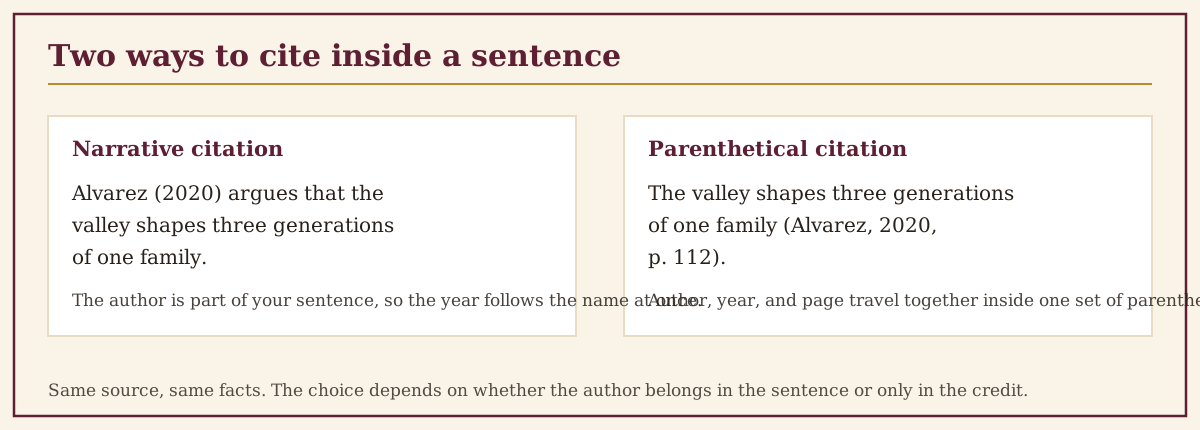
Parenthetical: the claim that valleys store family memory has a long history in the region (Alvarez, 2020). Narrative: Alvarez (2020) traces that memory through three generations of one family. A direct quotation adds the page in either form: (Alvarez, 2020, p. 112), or Alvarez (2020) calls the valley "a ledger nobody agreed to keep" (p. 112).
Two authors
Nair, P., & Okafor, T. (2021). Field notes on rivers. River Press.
The ampersand belongs to the reference list and to parenthetical citations: the survey protocol pairs walking with sketching (Nair & Okafor, 2021). Inside your own sentence the word and takes its place instead: Nair and Okafor (2021) describe their method as slow looking. Mixing the two, writing "Nair & Okafor (2021)" in running prose, is one of the most common APA slips.
An edited book
When a book is assembled by an editor rather than written by an author, the editor takes the author position and carries a role marker:
Brennan, C. (Ed.). (2018). Stories of the valley: An anthology. River Press.
One editor takes (Ed.) and several take (Eds.), and the marker appears once, after the complete list of names. In text the book is cited by the editor's surname like any author: (Brennan, 2018), or Brennan (2018) in narrative form.
A chapter in an edited book
A chapter citation names two works: the chapter you read, and the book that holds it. The chapter title stays in plain sentence case with no italics and no quotation marks, while the book title keeps its italics:
Okafor, T. (2018). The mill at Cedar Crossing. In C. Brennan (Ed.), Stories of the valley: An anthology (pp. 45-62). River Press.
The editor's name flips order here, initials first, because the In phrase reads as ordinary prose. In text, cite the chapter author, the person whose words you used: (Okafor, 2018, p. 51) for a quotation, and Okafor (2018) when his argument is paraphrased.
An ebook with a DOI
Print and electronic books share one format in APA 7; you do not name the platform, the device, or the format. When the ebook carries a DOI, the DOI closes the entry as a live link, after the publisher:
Jackson, L. M. (2019). The psychology of prejudice: From attitudes to social action (2nd ed.). American Psychological Association. https://doi.org/10.1037/0000168-000
This is the American Psychological Association's own worked example from its style site, and it quietly demonstrates three rules at once: the edition rides in parentheses after the title, the publisher needs no city, and the DOI stands last with no period after it, so the link stays clean. In text: (Jackson, 2019), and Jackson (2019) in narrative form.
An edition other than the first
Alvarez, J. (2023). The river between mountains (2nd ed.). River Press.
The edition statement is not italicized even though it touches the title, and a first edition receives no statement at all. Because pagination can shift between editions, the year in your citation must be the year of the edition on your desk, and your page numbers must come from that same edition.
Sentence case, the rule students resist
APA capitalizes book and article titles the way you would capitalize a sentence: the first word, the first word after a colon, and proper nouns. Everything else goes lowercase, including words that were capitalized on the cover. The River Between Mountains on the dust jacket becomes The river between mountains in the reference list, because Between is not a proper noun and does not open a subtitle. Journal titles are the exception in APA, keeping their headline capitals, which is why a reference list mixes the two patterns and looks inconsistent to an untrained eye. It is not inconsistent; it is two rules running side by side.
Side by side panels showing a narrative citation and a parenthetical citation for the same book
In text citations: the working rules
Three or more authors shorten from the very first citation: list the first surname and et al., as in (Osei et al., 2019) and Osei et al. (2019). APA does not wait for a second mention the way some styles do.
A paraphrase needs the author and year; a page number is encouraged but not required. A quotation always needs the page: p. for one page, pp. for a range, with the numbers written in full, pp. 45-62 rather than pp. 45-2.
When the author is an organization, spell the full name at first citation and add a bracketed abbreviation if you will use it again: (American Psychological Association [APA], 2020), then (APA, 2020) after.
Two sources in one parenthesis are separated by semicolons and alphabetized: (Alvarez, 2020; Nair & Okafor, 2021).
A work with no author moves its title into the author position, italicized for a book: (The river between mountains, 2020).
Ordering the reference list when one author repeats
Alphabetical order by author surname is only the first sort. When your list holds several works by the same person, APA applies a small stack of tie breakers that students rarely learn until a grader teaches them. A work by Alvarez alone precedes a work by Alvarez with coauthors, because nothing precedes something. Among coauthored works, order follows the second author's surname, then the third. Works by the same author or the same author team are then arranged by year, earliest first, which lets a reader watch an argument develop across a career.
The final tie breaker appears when one author publishes two books in a single year. The entries are ordered alphabetically by title, and the year grows a letter suffix in both the list and every in text citation: (2020a) for the title that sorts first and (2020b) for the next. The suffix is part of the date element, not a footnote trick, and it must match everywhere the source is cited, or a reader cannot tell which Alvarez book a claim came from. One author entries also precede entries for an organization with a similar name, and an author cited under a changed name is listed exactly as the name appears on each book, letting the title pages, not your knowledge of the person's biography, govern the list.
Translated books and missing information
A translated book credits the translator in the title element, in parentheses right after the title, and names the original publication year at the very end when the gap matters:
Hesse, H. (2002). Siddhartha (J. Neugroschel, Trans.). Penguin Classics. (Original work published 1922)
In text, both dates travel together in the citation: (Hesse, 1922/2002). The pattern feels heavy for a single reference, yet it solves a real problem, since a reader quoting page 40 needs the translation you read, while a reader tracing the argument needs the century it came from.
Missing information has honest workarounds rather than inventions. A book with no publication date takes (n.d.) in the date slot, a convention common with online reference works. A book whose author is genuinely unknown moves the title forward, as the FAQ below shows, and is alphabetized by its first significant word. What APA never permits is guessing: a year estimated from a bookseller listing, or an initial expanded into a guessed first name, corrupts the record the list exists to keep. If the copyright page of your copy cannot answer a question, cite a library catalog record for the same edition and say nothing you cannot support.
Where APA students lose marks
Location nostalgia tops the list: writers trained on older editions still type a city before the publisher, and APA 7 wants none of it. Next comes the headline capitalized title, copied faithfully from a cover that was designed by a marketing department rather than a style manual. Full first names appear when initials belong. DOIs get pasted as raw strings from a database instead of the https://doi.org link form, or worse, a database name like EBSCO is credited as if it were a publisher. Finally, writers italicize the edition statement because it sits beside the title. Every one of these errors survives spell check and most citation generators, because generators copy whatever a catalog record hands them, errors included.
Run the reference list against the pre-submit check below before the paper leaves your desk.
Interactive tool
Reference List Pre-Submit Check
Check off each step as you finish it. Your progress stays on this page.
0 of 10 complete
0% done
Decorative plate from the Book Reports and Citations shelf of the Castroville Reading Guide catalogue
Frequently asked questions
Does APA require the publisher's city for a book?
No. The seventh edition removed publication location from book references entirely. Give the publisher's name only, and if the publisher is the American Psychological Association itself, as with its own manuals, the publisher element is omitted because author and publisher are the same.
How many authors does APA list before using et al. in the reference list?
Up to twenty authors are written out in full in the reference entry. When a book has twenty one or more, list the first nineteen, add an ellipsis, and close with the final author's name. The shortening to et al. applies to in text citations, not to the list itself.
Do I cite the ebook format, like Kindle or PDF?
No. APA 7 uses a single format for a book in any medium. You never name the device, the app, or the file type. Add the DOI when the ebook has one; otherwise the entry is identical to the print entry.
What year do I use if my copy is a reprint?
Use the copyright year of the edition you consulted, which the copyright page states. If a classic work is republished, the reference takes the year of the version you read, and you may add the original year at the end of the entry when the history matters to your argument.
How do I cite a book with no named author?
Move the title into the author slot, italicized, followed by the year: Field notes on rivers. (2021). River Press. Alphabetize the entry by the first significant word of the title, and in text use the italic title with the year.
Should in text citations use the ampersand?
Only inside parentheses. A parenthetical citation reads (Nair & Okafor, 2021), while a narrative citation spells the connector out: Nair and Okafor (2021). The reference list uses the ampersand as well, before the final author's name.
How do I cite an audiobook in APA style?
Cite the book itself, in the same format as print, when your argument concerns the content. When the narration matters to your point, such as a memoir read by its author, add the narrator in the title element in brackets and the audio publisher as the source, so a reader can find the same performance rather than a different recording of the same words.