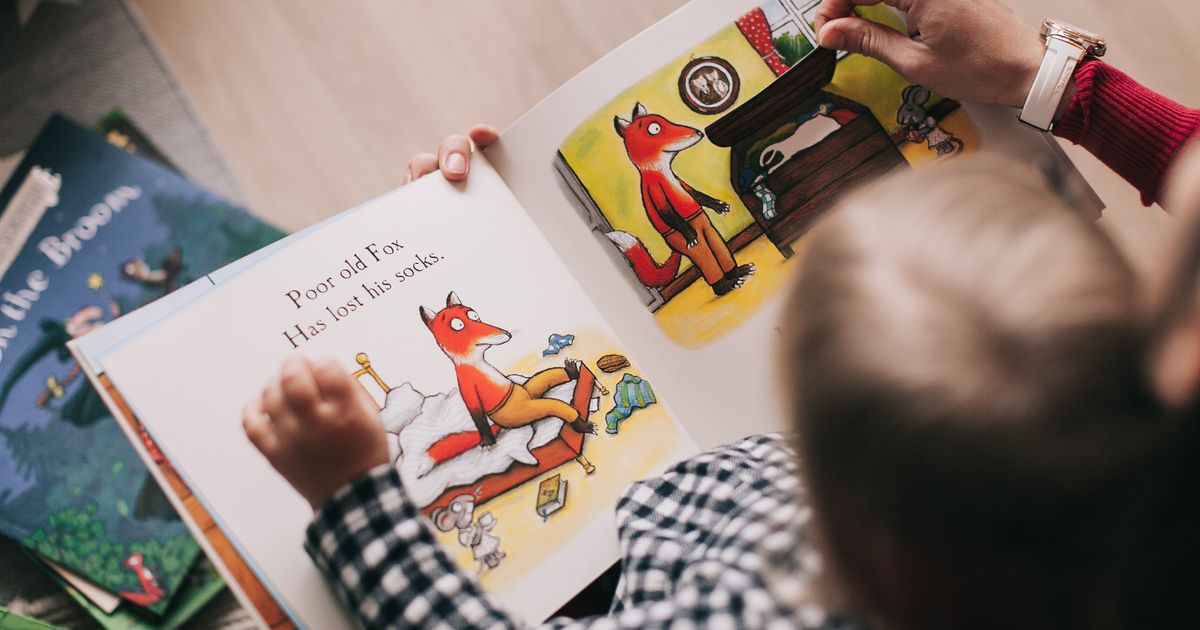
Pictures in a chapter book are not training wheels, whatever the playground consensus says. They are load bearing: they carry setting, expression, and jokes the prose leaves out, they rest a new reader's decoding muscles at planned intervals, and for many children they are the reason the book gets finished at all. This page arranges chapter books with pictures as a ladder, by how much art helps. The bottom rung is art on every spread, where the pictures are co narrators. The middle is art on most pages, where they confirm and extend the text. The top is spot art per chapter, a plate here and there, where the reader has quietly taken over the picturing job. Every rung lists real books with their authors, and the point of the ladder is movement at the child's pace, not eviction from the lower rungs, which remain legitimate reading for as long as they are loved.
Rung one: art on every spread
Mercy Watson by Kate DiCamillo, illustrated by Chris Van Dusen, is the ladder's ground floor and its most joyful room. Van Dusen's full color paintings appear on nearly every spread, wide and warm, and they do not merely repeat the text: the expressions on the Eugenia Lincoln's face, the exact physics of a bed falling through a floor, live in the pictures. A reader can follow the whole chase visually and use the words to confirm, which is the precise support a five or six year old needs. Narwhal and Jelly by Ben Clanton sits at the edge of the category, an early graphic novel in chapter like episodes, where a happy narwhal and a skeptical jellyfish meet waffles, friendship, and small adventures told almost entirely in pictures and speech bubbles. It belongs on this page because it is the book picture dependent readers reach for first, and because its panel storytelling teaches sequence and inference that transfer directly to prose. The Princess in Black by Shannon Hale and Dean Hale, illustrated by LeUyen Pham, completes the rung with action: full color art on every spread, a princess who fights monsters between tea parties, and chapters that end on genuine cliffhangers, proving to skeptical children that a book with this much picture in it can still be a page turner.
Rung two: art on most pages
Owl Diaries by Rebecca Elliott is built as Eva Wingdale's own diary, and its pictures, Eva's doodles, lists, and drawings, are the narration's second voice. The format flatters a growing reader twice over: the diary entries break the text into short daily chunks, and the art is integrated into the page rather than interrupting it, so the eye learns to graze between word and image without losing the thread. Dragon Masters by Tracey West, illustrated by Graham Howells, runs black and white art through most chapters, placed at the reveals, the new dragon, the training exercise, the battle, so the pictures function as rewards spaced through the text. A reader on this rung is doing most of the picturing alone and checking the artist's version at the exciting parts, which is a lovely and underpraised stage of reading development. Ivy and Bean by Annie Barrows, illustrated by Sophie Blackall, puts its pictures where the jokes are: Blackall's ink drawings catch the exact facial expressions Barrows's prose sets up, and the books teach their reader that illustrations in a chapter book can be a second comedian rather than a narrator, a lesson that recalibrates what pictures are for.
Rung three: spot art, and the reader takes over
Magic Tree House by Mary Pope Osborne carries black and white illustrations at intervals, a plate every chapter or two, and by this rung the pictures have become landmarks rather than support: the reader pictures the dinosaurs and knights herself and meets the artist's version occasionally, the way a traveler checks a map after walking the road. The Wild Robot by Peter Brown is the ladder's top and its proof of concept. Brown, an illustrator first, rations his own art to occasional full page plates, sometimes letting thirty pages of prose pass unillustrated, and the effect on a ready reader is electric: the island, Roz, and the animals are built in the mind, and the rare plate lands like a window opening. A child who finishes The Wild Robot has not stopped liking pictures. She has learned to make them, which was the destination all along.
The picks at a glance
| Book | Author and illustrator | Picture density | The art's job |
|---|
| Mercy Watson | Kate DiCamillo, Chris Van Dusen | Every spread | Co narrator |
| Narwhal and Jelly | Ben Clanton | Every page, panels | Primary storyteller |
| The Princess in Black | Shannon and Dean Hale, LeUyen Pham | Every spread | Action and suspense partner |
| Owl Diaries | Rebecca Elliott | Most pages | The narrator's own doodles |
| Dragon Masters | Tracey West, Graham Howells | Most chapters | Rewards at the reveals |
| Ivy and Bean | Annie Barrows, Sophie Blackall | Regular spot art | Second comedian |
| Magic Tree House | Mary Pope Osborne | A plate per chapter or two | Landmarks |
| The Wild Robot | Peter Brown | Occasional plates | Windows in self built walls |
How to climb, and when not to
Climb when the current rung starts to feel like a waiting room: the child finishes books fast, complains that the pictures show her what she already imagined, or begins choosing text heavier books at the library unprompted. Offer the next rung as an upgrade with ceremony, the way you would a bigger bicycle, and keep the lower rungs in the house without commentary, because regression to a beloved picture rich book on a tired day is not a step backward; it is reading for comfort, which adults do constantly and children should be allowed to do without an audit. Do not climb because a classmate has, because a chart says so, or because a relative raised an eyebrow at the pictures. The eyebrow is wrong on the merits. Illustration in children's books is an art form with masters on this very page, and the child absorbing Van Dusen's composition and Blackall's line is getting an arts education alongside her literacy one. The ladder's only real rule is that the child holds the railing.
A note for the adults who buy these books
Illustrated chapter books cost more to produce and sometimes more to buy, and families occasionally ration them in favor of text only books that look like better value per page. Count differently. Value per finished book is the metric that builds readers, and a finished Mercy Watson, pictures and all, is worth more to a six year old's future than an abandoned text only novel of twice the length. Libraries solve the cost problem for most families, and the illustrated series are exactly what library cards are for. Buy the ones that get reread until the binding sighs. On this page, that is usually Mercy Watson and The Wild Robot, the two ends of the ladder, which between them can carry a child from first chapters to the edge of middle grade with pictures helping all the way, less and less visibly, until one day the help is coming from inside the reader and the ladder can be put away, still standing, for the next child.
What the pictures are actually teaching
It is worth being precise about the pedagogy, because the case for illustrated chapter books is stronger than permission; it is instruction. A picture that shows the character's face during a line of dialogue teaches the reader to attach feeling to text, the foundational act of comprehension, and it does so at the exact moment the text needs it. A picture that shows the setting, the tree house's rope ladder, the dragon school's courtyard, builds the reader's store of visualizable worlds, the library of images she will draw on when later books describe places in words alone. Sequential pictures, in the graphic and heavily illustrated rungs, teach inference across gaps: the reader who follows Narwhal from one panel to the next is practicing the same bridging work she will later do between paragraphs. And the rhythm of text and image teaches pacing, when to hurry and when to dwell, which fluent readers do unconsciously and struggling readers must be shown. None of this is visible on a reading log, which is why illustrated books are undervalued by systems that count pages. The learning is in the alternation, and the alternation is the design.
Choosing illustrated books well
Not all picture support is equal, and the shelf rewards a discriminating eye. Prefer art that adds information, expressions, settings, jokes the words did not tell, over art that merely decorates a scene the prose already completed, because the first kind teaches and the second only rests. Prefer illustrators with a consistent visual world across a series, since a reader builds fluency in a visual language just as in a verbal one, and Van Dusen's Mercy Watson volumes and Blackall's Ivy and Bean are models of that consistency. Check where the pictures fall: at chapter ends and reveals, they reward; at random, they interrupt. And respect the child's own art opinions, which arrive earlier and stronger than adults expect. A reader who loves an illustrator will read that illustrator's hardest book, which is a lever worth more than any level chart. Buy the art she loves in hardcover if the budget allows. She will keep those books, and one day read them to a child whose ladder is just being built.
Reading the pictures together: a habit for the lower rungs
While a child is on the first two rungs, one small adult habit multiplies the books' value: occasionally, read the pictures on purpose. Pause at a spread and ask what the artist showed that the words did not say, whose face changed, what is happening in the corner of the room, what the next page's picture promises. This is not a quiz and should never become one; it is modeling, the adult demonstrating that pictures in these books are read, not merely looked at, and that a reader's job includes them. Children who are read to this way begin doing it silently and alone, narrating spreads to themselves, which is the exact behavior that later becomes visualizing prose. The habit costs perhaps a minute a chapter and pays out for years. It also, not incidentally, makes the adult a better viewer of the art itself, which on this page includes some of the finest illustration being published anywhere, a fringe benefit of parenthood that nobody warns you about and everybody remembers.
For the child who reads the pictures and skips the words
Every family with this shelf eventually meets the phase in which the child flips through a new book looking only at the pictures, announces it finished, and reaches for the next. Treat the phase as reconnaissance rather than fraud. She is previewing, building the story's map in images so the words, when she returns to them, have somewhere to land, and many fluent readers retain a version of the habit for life. The productive response is curiosity, not policing: ask what she thinks the book is about from its pictures, and let her discover, in the telling, the gaps only the words can fill, a motive here, a joke there, the name of the thing in the corner. Then read the first chapter aloud together, pictures and all, and hand it back. Most picture skippers are not avoiding reading; they are reading in the order their current skills prefer, images first, and the ladder works precisely because it lets the order reverse itself gradually, rung by rung, without a single battle.
More series and chapter book guides
Frequently asked questions
Are chapter books with pictures too easy for a 7 year old?
No. Picture density tracks support, not intelligence, and the top of this ladder, The Wild Robot, is read with pleasure by ten year olds. Match the rung to the reader's stamina and mood, not to a birthday.
Will pictures stop my child from learning to visualize?
The evidence of every reading childhood says the opposite: children move from supplied pictures to self made ones gradually and voluntarily, using early illustrations as the training set for their imagination.
What is the most illustrated real chapter book series?
Mercy Watson, with full color art on nearly every spread inside a genuine chapter structure. Narwhal and Jelly goes further into panels and is best described as an early graphic novel.
How do I know which rung my child is on?
Hand her the middle rung. If she reads it happily and asks for more, she is there. If she flips ahead looking for pictures to rest on, drop a rung without comment and try again in a season.
Do illustrated chapter books count for school reading logs?
They should, and in most classrooms they do. If a log is being used to police pictures out of a child's reading, that is a conversation worth having with the teacher, politely and with this ladder in mind.