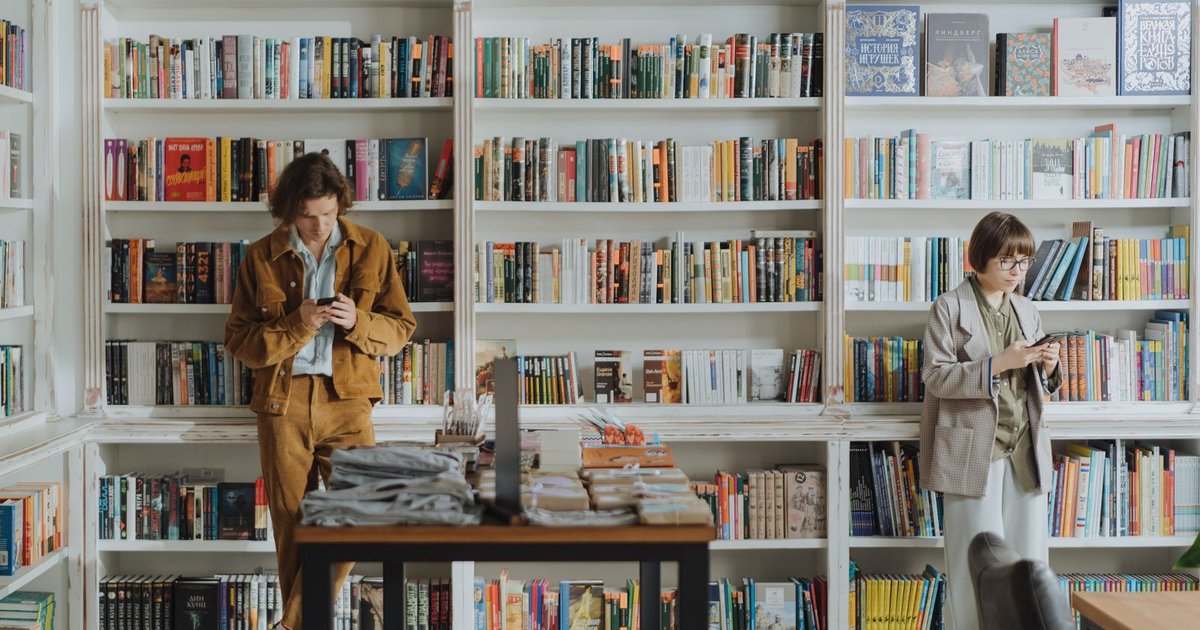
Bookshops as healing places
Welcome to the Hyunam-dong Bookshop by Hwang Bo-reum, translated from the Korean by Shanna Tan, is the closest match in spirit. Yeongju leaves a high flying career, a husband, and a burned out life in Seoul, and opens a small bookshop in a residential neighborhood. The shop disappoints her at first, then slowly becomes the place where lost souls gather, a barista with his own stall, a customer who knits through her grief, and where books and friendship change situations for the better, including her own. Where Aoyama's helper is a librarian who heals others, Hwang's is a bookseller being healed by her own shop, and the reversal gives the book its ache: the person who built the refuge needs it most. It is the first recommendation on this page for nearly every reader, and the one whose final chapters feel most like Komachi's library at closing time.
Days at the Morisaki Bookshop by Satoshi Yagisawa, translated from the Japanese by Eric Ozawa, follows Takako, a woman whose life has stalled, betrayed by a boyfriend and adrift, who moves into a room above her uncle Satoru's secondhand bookshop in Tokyo's Jimbocho book district while she decides what her life is for. It is quieter and more inward than Aoyama, with the same faith that a bookshop can hold a person until they are ready to move, and its Jimbocho, a real neighborhood of bookshops, gives the healing an address. The book is short, the gentlest full length entry here, and its sequel continues the story for readers who finish it in a weekend and immediately want the room above the shop back.
Kind helpers, one life at a time
Before the Coffee Gets Cold by Toshikazu Kawaguchi, translated from the Japanese by Geoffrey Trousselot, moves the helper premise into a small Tokyo cafe that offers its customers a chance to travel back in time, under strict rules, in one particular seat, and only until the coffee gets cold. A quartet of visitors comes hoping to confront a partner who left, receive a letter from a husband whose memory is going, see a beloved sister once more, or meet a daughter they never knew. Like Aoyama, it argues that you cannot undo the past, but you can change how you carry it, and its rules, recited like a liturgy in every story, become the point: the past is fixed, the heart is not. It is sadder than Aoyama and more theatrical, a play's structure wearing a novel's clothes, and readers should expect tears as a feature.
The Kamogawa Food Detectives by Hisashi Kashiwai, translated from the Japanese by Jesse Kirkwood, swaps books for meals. In a hidden Kyoto diner with no sign, Nagare Kamogawa, a former detective turned chef, and his daughter Koishi work as food detectives, investigating and recreating the one dish from a customer's past that they cannot stop thinking about, a lost wife's stew, a childhood noodle, a taste that means home. The structure will feel familiar at once: a seeker arrives stuck, a gifted helper listens closely, asks the questions nobody else thought to ask, and the right remembered thing points the way forward. It is the warmest book here and the hungriest, and readers who finish Aoyama wishing Komachi also cooked will feel personally served.
Sweet Bean Paste by Durian Sukegawa, translated from the Japanese by Alison Watts, Aoyama's own translator, is the gentlest pick here. Sentaro, stuck running a small dorayaki confectionery shop after a failed writing dream and a prison record, is changed by Tokue, an elderly woman with gnarled hands who asks for work and whose bean paste recipe and hard won wisdom teach him a craft and a way back to people. Tokue's history, shaped by the long shadow of Hansen's disease in Japan, gives the book a depth its sweetness never announces, and its argument, that a life the world discarded can still be the one that saves yours, is Aoyama's argument carried by an older and braver pair of hands. It has no magic at all, and it may be the most Aoyama like in heart.
The library itself, and one step beyond
Summer Hours at the Robbers Library by Sue Halpern is the library centered pick, and the only American novel here. Kit, head librarian in Riverton, New Hampshire, has made her library a solace where no one asks about her past, in a town whose factory closed and whose library stayed open. Then Sunny, a troubled teenager assigned to community service at the library after shoplifting a dictionary, arrives for the summer, and two guarded people repair broken bonds side by side, among patrons who use the library the way Aoyama's guests do, as the last public room that asks nothing of them. It is Aoyama's pattern in an American key, with more plot and more weather, and librarians recommend it to each other for a reason.
The Midnight Library by Matt Haig takes the biggest step. Between life and death, Nora Seed finds a library where every book is a life she could have lived, tended by her old school librarian, and with that help she tries her regrets on, one volume at a time: rock star, glaciologist, mother, swimmer, each life teaching her what the wanting was actually for. It is sadder and more philosophical than Aoyama, and it deals directly with depression and regret, so choose it when you want the library idea at full metaphysical stretch rather than cozy scale. It is also the most famous book here by a wide margin, and readers who come to this page from Haig, traveling backward toward Aoyama, should know the traffic runs happily in both directions.
How to choose your strand
Start with the Hyunam-dong bookshop if you want the feeling preserved whole. None of these books copies Komachi herself, that uncanny reading of a stranger's need, delivered without explanation and never wrong. What they share with Aoyama is her conviction, delivered at low volume, that the right book, meal, or room, offered at the right moment, can restart a life. A note on the shelf as a whole: most of these novels arrive in English through translation, Japanese and Korean chiefly, and the translators are named in the paragraphs above because their work is the reason the gentleness survives the crossing. Readers who fall for this shelf often find they have acquired a taste, cozy fiction, healing fiction, the Japanese and Korean schools of the low stakes novel, and that taste, once acquired, is one of reading's most reliable comforts: a shelf that will never raise its voice at you, and never needs to.
Komachi's method, examined, because the shelf copies it
It is worth slowing down over what Aoyama's librarian actually does, because every author on this page has studied the trick and each reproduces a different part of it. Komachi's consultations look like reference interviews and behave like diagnosis. A visitor arrives with a surface request, a book about computers, a book about cake, and a life quietly stuck underneath it: a career that ended, a retirement that frightens, a child not yet confessed to anyone. Komachi listens, asks very little, types with enormous stillness, and produces a list in which one title is always wrong for the request and right for the life, plus a felted charm, a crab, a plane, a cat, whose meaning the visitor must decode alone. The genius of the device is its restraint. She never explains herself, never follows up, never claims the change that follows, and the novel never confirms whether her gift is intuition, research, or something the library itself does through her. Healing, in Aoyama's theology, is a recommendation plus privacy: the right book, and then being left alone with it.
Measured against that method, the shelf sorts itself beautifully. Hwang's bookseller inverts it, recommending to others while her own prescription goes unfilled, so the book becomes a study of the helper's blind spot. Kawaguchi's cafe mechanizes it, rules instead of intuition, the same seat, the same cooling coffee, the helper reduced to a guardian of procedure while the visitors heal each other. Kashiwai's food detective is Komachi's closest professional relative, a listener whose research happens offstage and whose delivery, a recreated dish, is her felted charm made edible. Sukegawa removes the gift entirely: Tokue has no intuition about Sentaro, only a craft, a history, and time, and the healing takes a season instead of an afternoon, which is why his book is the one readers call the most realistic. Halpern distributes the gift across a whole public library and its patrons, an American answer to a Japanese device: no single seer, just a building full of people practicing small perception on each other. Haig finally enlarges the gift to infinity and asks what it costs, a librarian with every life on the shelf and a visitor who must learn that the right book was never the problem. Read in this page's order, the shelf is a seminar on a single question, how much help one person can decently offer another, and Aoyama's answer, one book, one charm, no explanation, remains the most elegant on the table.
A note for librarians, booksellers, and the people who hand these over
This shelf has a professional readership, and it deserves a paragraph of its own. Komachi has become a kind of patron saint for working librarians, who recognize in her the idealized form of their own readers' advisory work: the patron who asks for one thing and needs another, the recommendation that must be made in ninety seconds and defended never.
More read-alike guides
Frequently asked questions
What should I read after What You Are Looking For Is in the Library?
Welcome to the Hyunam-dong Bookshop, the closest match in spirit, a burned out woman healed by the bookshop she builds for other lost people. Days at the Morisaki Bookshop is the next step, quieter and shorter, and The Kamogawa Food Detectives is the pick when the helper structure mattered more than the books.
Is Aoyama's novel part of a series?
No, it is a stand alone novel of linked stories, five visitors to Komachi's library whose lives touch at the edges. Several picks here do continue: the Morisaki bookshop has a sequel, Before the Coffee Gets Cold opens a series, and the Kamogawa detectives return, so readers who want more of a world they love are well served.
Which pick is most like Komachi herself?
Nagare Kamogawa, the food detective, shares her method most exactly: he listens to what a customer says, hears what they mean, investigates quietly, and hands back the one thing, a dish instead of a book, that restarts a life. Mrs. Elm in The Midnight Library is her metaphysical cousin, a librarian who knows what a visitor needs among infinite shelves.
Are these books sad?
Gently, in places, the way Aoyama is sad: grief, regret, stalled lives, and lost people are the raw material, and Before the Coffee Gets Cold and The Midnight Library will make many readers cry. The shelf's promise is not the absence of sadness but its handling, at low volume, with kindness, and with endings that return their people to life.
What is this kind of book called?
Cozy fiction, or healing fiction, the term used for the Japanese and Korean schools of low stakes novels about bookshops, cafes, libraries, and small brave changes. Readers who want more after this page can search those terms at any library and find a deep and growing shelf, much of it in translation.