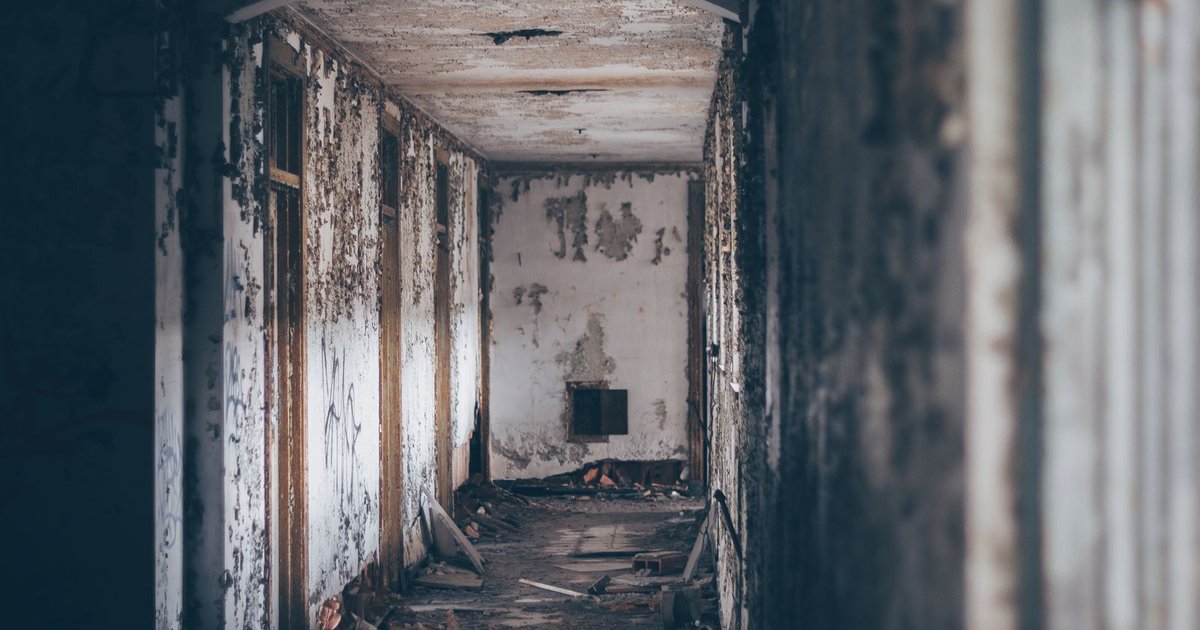
If the impossible house caught you
Piranesi by Susanna Clarke is the gentlest true match in print. Her narrator lives in an endless house of halls lined with statues, where tides move through the lower levels and an albatross can arrive like a blessing, and he records everything in detailed journals while slowly realizing his reality is broken. It matches the spatial wonder of the anchor's hallway with a solitary, lyrical voice instead of dread, and readers who found the anchor's violence hard will find this a kinder walk through endless rooms. It is also short, the only book here that can be read in a weekend without heroics, and its kindness is not softness: the house is a prison as well as a cathedral, and Clarke lets her narrator love it anyway, which is the bravest choice on this page.
You Should Have Left by Daniel Kehlmann is the same trap at novella length: a screenwriter renting a remote mountain house with his family notices that the interior walls measure slightly wider than the outside foundation, and the brief book captures the creeping domestic panic of measuring a home that will not agree with itself, without the footnotes. Read it in one sitting, ideally in the evening, and notice how Kehlmann gets the anchor's central effect, geometry as dread, from a tape measure and a notebook instead of from labyrinths. It is the correct first step for a reader who wants the dread without the labor, and its ending refuses comfort as firmly as the anchor's does.
The Grip of It by Jac Jemc brings the trap back to a marriage. Julie and James move into a new home hoping for a fresh start, and strange drawings appear on the walls, hidden rooms turn up, and unexplained bruises mirror the stains spreading through the house, told in short alternating chapters by two increasingly unreliable voices. Jemc's innovation is to make the house a third partner in a relationship already carrying debt and disappointment, so every haunting can be read as architecture or as marriage, and the book never tells you which reading is the merciful one. It is the most traditionally frightening book in this section and the one whose dread lingers longest after closing it.
If the strange page caught you
The Raw Shark Texts by Steven Hall is the closest stylistic match available. Eric Sanderson, an amnesiac, is hunted by a conceptual shark, a predator made of ideas that swims through language and eats memory, and Hall uses concrete typography, visual puzzles, and even flip book sequences to make the page itself behave like the threat. Its emotional core is grief rather than cold horror, which makes it the natural next step for a reader who loved the anchor's format experiments most: the typography here is not decoration but the monster's body, and a chapter can be a shape you read the way you would read a room. It is also, underneath the invention, a love story about what memory loss costs the people who remember for two.
Pale Fire by Vladimir Nabokov is the ancestor of the whole device. A long poem by an American poet arrives buried under a foreword and hundreds of endnotes by its editor, Charles Kinbote, who hijacks the commentary to narrate the escape of a deposed king from an imaginary kingdom, and may be inventing all of it, including, some readers argue, himself. Readers who loved dissecting the dueling perspectives and scholarly parody of Zampano's chapters will find the original here, sharper and funnier than its descendants. It asks the anchor's central question in a purer form: when the apparatus around a text is this alive, which layer is the book? Nabokov's answer is a trap with better jokes, and finishing it will permanently change how you read every footnote on this page.
If the obsessive archive caught you
Night Film by Marisha Pessl rebuilds the archive as an investigation. A reporter, Scott McGrath, probes the death of Ashley Cordova, daughter of a reclusive cult horror director whose films are legend and contraband, and the narrative embeds fictional forum threads, clippings, diary entries, and photographs throughout. It is the most propulsive pick on this page, a thriller engine carrying the anchor's archival pleasures, and its director, Stanislas Cordova, is Zampano's mirror: a maker whose work may be a door into something real, pursued by a man whose obsession is ruining his life in the approved Truant manner. Readers who found the anchor slow should start here, where the archive has a body count and a deadline.
Annihilation by Jeff VanderMeer shrinks the archive to one field journal: a biologist on a four woman expedition into Area X, an abandoned coastal region, records spatial distortions and a living tunnel whose walls pulse with organic script, in clinical notes that slowly stop being clinical. It echoes the quiet dread of exploration and the breakdown of scientific observation, at a fraction of the anchor's length, and its tower that descends and its lighthouse that accuses will feel like the hallway's cousins, spaces that are also texts. It opens a trilogy, but the first volume stands alone as the purest dose of this strand: a document written by someone the place is editing.
Episode Thirteen by Craig DiLouie closes the strand in found footage form: the crew of a ghost hunting television show enters a decaying mansion once used for bizarre experiments, and the story unfolds through transcripts of recorded footage, journal entries, and emails, inviting you to piece together an ordeal you should not be looking at. The reality television frame sounds like a gimmick and behaves like an accelerant, because every document in the book was made to be watched, and the horror arrives precisely when the cameras' account and the journals' account stop agreeing. It is the most fun book here and, in its final movement, among the most frightening.
How to choose your trap
The page ends on a warning. Every book here demands patience and a tolerance for ambiguity, and none of them resolves the way the anchor refuses to resolve. That refusal is the genre. If you want the dread without the labor, start with Kehlmann. If you want the labor itself, the strange page strand is waiting, and it starts with a shark made of words. A physical note, because this shelf is unusually physical: the anchor and Pale Fire and The Raw Shark Texts are books whose print editions are part of the work, with layouts, colors, and page shapes that ebooks flatten or lose. Read this shelf in print when you can. The house, in every sense, is the paper.
A short history of the strange page, for readers who want the lineage
The anchor did not invent its machinery, and knowing the lineage makes the shelf above read as a conversation across sixty years rather than a set of imitations. Nabokov's Pale Fire, on this page, perfected the hijacked apparatus in 1962: a text, a commentator, and a reader forced to decide which layer is lying, with the comedy and the tragedy generated by the same sentences. The decades after produced the other ancestors this page draws on quietly, writers who treated the book as an object, footnotes as a second novel, indexes as traps, and typography as weather. Danielewski's contribution, arriving in 2000, was to fuse that literary lineage to horror's engine and to the internet era's found footage instincts: his house is a haunted house, his archive is a haunted archive, and his page, with its colored words, its passages that must be rotated, its lists and labyrinths of type, is the haunting's third location. Readers who finish the anchor hungry for the tradition itself should read Pale Fire next, whatever strand they loved, because it is the one book here that makes all the others, the anchor included, look like descendants, and it does so while being, scene for scene, the funniest volume on this page.
The lineage also runs forward, and two of its directions are represented above. One is the documentary direction, Pessl and DiLouie, where the archive becomes evidence and the reader is cast as investigator, a form the internet trained a generation to read natively, in threads, screenshots, and transcripts. The other is the spatial direction, Clarke and VanderMeer, where the impossible place is rendered not through typography but through a narrator's deteriorating record of it, journals and field notes whose reliability the place itself is editing. Kehlmann proves the minimal case, that a tape measure and a notebook suffice; Hall proves the maximal one, that a page can be made to swim. A reader who works through this page in its strand order will have, by the end, a working education in what fiction can do with paper, which is a considerable thing for one shelf to teach.
Practical counsel: editions, pacing, and reading companions
Three pieces of practical counsel close this page, earned from how readers actually succeed with this shelf. First, editions: read in print, as the main text urges, and for the anchor specifically seek the full color or remastered printings, where the word house appears in blue and the typographic effects are intact; a plain text digital edition of this particular novel is a genuinely diminished object, closer to a summary of the experience than the experience. Second, pacing: these are not books to race. The anchor famously rewards a pencil, markers, and a willingness to reread a chapter the moment it ends, and Pale Fire's ideal reader flips back constantly, treating the index as a map. Readers who budget these books by the month rather than the weekend report finishing them; readers who treat them as ordinary novels report abandoning them at the exact chapters where the machinery was about to pay off. Third, companionship: this is the most discussable shelf on this site. Every book here sustains an argument about what actually happened, and a reading partner, a club, or even a notebook kept in a second voice will double the pleasure.
More read-alike guides
Frequently asked questions
What is the closest book to House of Leaves?
The Raw Shark Texts, for the page itself behaving strangely in service of a predator made of language, and Piranesi for the impossible house rendered gently. Which one is closest depends on which trap caught you, the format or the floor plan, and this page is sorted to let you answer that first.
Is Piranesi scary?
No, not in the anchor's way. It is eerie, melancholy, and ultimately kind, a book about a man who loves the impossible house that imprisons him. Readers who bounced off the anchor's dread often call it the version of the idea they always wanted. Readers who wanted the dread should start with The Grip of It instead.
Should I read Pale Fire if I have never read Nabokov?
Yes, and it may be the best door. You need nothing but patience: a poem, a mad commentary that keeps eating the poem, and a story assembling itself in the footnotes. It is funnier than its reputation and shorter than the anchor, and it will teach you how to read this entire shelf.
Are these books hard to read?
They range widely. You Should Have Left and Piranesi are short and welcoming, Annihilation is brief and hypnotic, and Night Film is a thriller that happens to be built from documents. Pale Fire and the anchor itself are the deep water. The table's sequence, gentlest first within each strand, is the intended reading order for a reason.
Do any of these books explain their mysteries?
No, and that is the honest headline of this shelf. Each book explains more than the anchor does about some things and less about others, but every one of them protects a central refusal. Readers who need resolution should choose Night Film, whose investigation answers the most, and accept that even it leaves its largest door closed.